
Introduction

Welcome, to the training units for becoming a Brain Lobes Expert! Dive into an adventurous travel through Brain Land to discover how your brain works!
Brain Land is divided in 4 areas: Occipital, Frontal, Parietal and Temporal.There are many things happening in your brain right now that controls how you feel, speak, think, move, and much more. In order to understand these functions, you will need to travel at each of these areas!
Have you ever wondered why your brain is so complex?
Your brain is like a powerful computer that stores our memory and controls our thoughts. Just as your computer contains many small wires that connect information, your brain contains billions of nerve cells that send and receive information around your body!
During your journey in the training units, YOU will be looking at the FOUR main LOBES (or parts)! 
Task
HERE IS WHAT YOU HAVE TO DO!
Your team will be exploring the four main lobes of the brain! After you finish this amazing Brain Land Trip, you will be a brain expert! You will work with fellow lobe specialists to come up with a script or poster representing each of these lobes, with everything you have learned about what they do and what happens when they are injured!
Your travel in Brain Land will last 3 weeks.
Week 1: Know your land - Gather information on one of the 4 brain lobes.
Week 2: Brain Lobes Training - Fun Brain activities and Games.
Week 3: Brain Quiz and Presentations

Have FUN!
Process
Here is what you have to do in more details:
To get started on your journey, explore the link below! It shows the Brain and its lobes.
Week 1
Step 1: You will watch a longer video about the brain lobes.
Remember to watch this video to give a good start to your journey! It's the Brain Song!
[video:https://www.youtube.com/watch?v=QPLZ_WUsK88]
Write notes on:
- the names of the four lobes
- the senses and functions related to each lobe
- important concepts
- prepare questions for the teacher to answer
Steps 2 and 3: You will be divided into groups of four by the teacher.
Each team member will have to choose one brain lobe (part) of the following:
- Frontal Lobe
- Parietal Lobe
- Occipital Lobe
- Temporal Lobe
Step 4: Answer the following questions on YOUR brain lobe!
- Which lobe did you choose?
- Where is the lobe located on the brain (e.g. at the back, at the front etc.)?
- Why is this lobe important? State at least 3 of its functions.
- What happens if this lobe of the brain is damaged or injured? State at least 2 possible effects.
Step 5: Finish up by coloring your brain lobe - a coloring sheet will be provided by the teacher!
Be creative!
SOME WEBSITES TO HELP YOU BECOME BRAIN EXPERTS:
- 1. Frontal Lobe
http://brainmadesimple.com/frontal-lobe.html

- 2. Parietal Lobe
http://brainmadesimple.com/parietal-lobe.html

- 3. Occipital Lobe
http://brainmadesimple.com/occipital-lobe.html

- 4. Temporal Lobe
http://brainmadesimple.com/temporal-lobe.html

GENERAL Sources to help you:
- http://www.brainline.org/multimedia/interactive_brain/the_human_brain.html?gclid=CN-A1YrLqb0CFe99OgodpCQA1w
- http://faculty.washington.edu/chudler/lobe.html
- http://brainmadesimple.com/cortex-and-lobes-of-the-brain.html
- http://faculty.washington.edu/chudler/revlobe.html
- http://science.education.nih.gov/supplements/nih2/addiction/activities/lesson1_brainparts.htm

Week 2:
FUN and ACTIVITIES week
- Since you have worked hard last week, you will have fun exploring the Brain Land areas through different activities:
STEP 1: Brain Land map: trace a map of Brain Land!
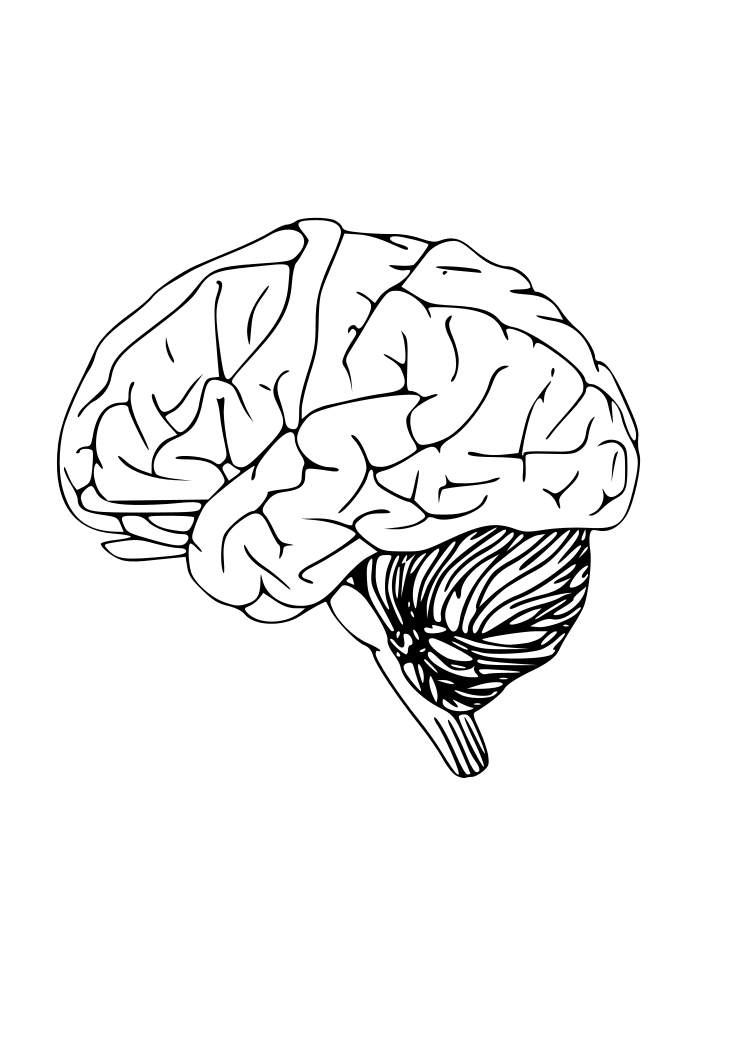
You will be given a map of Brain Land and will have to indicate the four main areas. To do this, you will have to colour each brain lobe in a different colour! BE CREATIVE
Here is the link for your brain map:
http://www.clker.com/cliparts/0/e/8/b/11949865491711712193brain_jon_phillips_01.svg
Here is a website to find some brain colouring pages to print the ones you like!
http://faculty.washington.edu/chudler/colorbook.html

STEP 2: Brain Puzzles and games!
DO ALL the following puzzles and games.
- http://faculty.washington.edu/chudler/flash/lobeg.html
- http://faculty.washington.edu/chudler/revlobe.html
- http://www.bungelab.berkeley.edu/KidsCorner/kidscorner/games.html
- http://its.sdsu.edu/multimedia/mathison/lobes/index.htm
STEP 3: Share and Practice
You are almost a Brain Lobes agent! The only thing left to do is to prepare for the BrainQuiz. To do so, share the information you collected on the lobe you chose with your group.
Week 3:
Step 1: To test YOUR knowledge, you will be given a short quiz about the four lobes online.
- Practice for the quiz on this site: http://faculty.washington.edu/chudler/java/newpuz.html
-
If needed, you can also review the general links from Week 1.
-
When you are ready to take the Brain Quiz, click on this link:
-
http://www.classmarker.com/online-test/start/?quiz=mmy533a3983ab825
-
When you finish the Quiz, a Results page will open. Leave it open until the teacher comes to verify it and help you print it.
Step 2: YOU and your team members will make a short script or a poster
A. Skit:
- Use 30 minutes to write a 2-3 pages script.
- Include the four main lobes of the brain.
- The other students in the class will have to guess which lobe is each member of your team representing.
- You have 5 minutes in total to act it out!
- Be creative and have fun!
OR
B.Poster
- Use 30 minutes to prepare a poster.
- Include the main lobes of the brain - use visuals!
- Your presentation will last 5 minutes.
- Your peers will ask questions at the end of your presentation
- Have fun and be creative!
Reminders - When presenting:
-
Make sure you speak loud enough.
-
Respect others.

Evaluation
This is how your work will be evaluated!
|
Student’s Rubric |
Very Poor |
Poor |
Good |
Expert |
Score |
|
Work independently |
The student needed teacher’s help with every exercise. |
The student needed a lot of help from peers to complete most of the exercises. |
The student needed a little help from peers for some of the exercises. |
The student worked independently without extra help. |
|
|
Read and understand information |
The student answered 0-1 questions correctly. |
The student answered 2-3 questions correctly. |
The student answered 4 questions correctly. |
The student answered all 5 questions correctly. |
|
|
Work collaboratively |
The student did not work with other members of the group. |
The student participated a little in the group work. |
The student participated well and collaborated with other members of the team. |
The student was active and enthusiastic throughout the group work. |
|
|
Brain Quiz |
The student received less than 5 points on the Quiz. |
The student received between 5 and 10 points on the Quiz. |
The student received between 11 and 16 points on the Quiz. |
The student answered all questions correctly. |
|
|
Skit or Poster Presentation (Group Grade)
|
The presentation was not well prepared. The members of the group did not follow the checklist provided and made many mistakes during the presentation. |
The presentation could have been better. The members of the group followed only part of the checklist provided and did some mistakes while presenting. |
The presentation was good. The members of the group followed the checklist provided but had a few mistakes during the presentation. |
The presentation was excellent. The members of the group followed all the directions provided in the checklist. There were no mistakes during the presentation. |
Conclusion
Congratulations, YOU are now officially a Brain Lobes Expert!
By exploring Brain Land and its wonders, you are an expert in its four areas, which are also your brain lobes! You can surely impress your biology teacher and peers with your expertise! Remember that your brain is like a computer which contains billions of nerve cells.
If you would like to know more about other important brain parts, here are some of them: corpus callosum, cerebral cortex, thalamus, cerebellum, hypothalamus, hippocampus and brain stem. Here is a fun video about some of these brain areas:
[video:https://www.youtube.com/watch?v=bLHutEdVEH4 align:center]

Credits
References:
Cagiltary, K., Kara, N. and Aydin, C. C. (2014). Smart toy based learning. Hand book of Research on Educational Communication and Technology, 703-711.
Howland, J. L., Jonassen, D., and Marra, R. M. (2012). Meaningful Learning with Technology (Ed 4). Boston, MA: Pearson Education.
http://www1.mels.gouv.qc.ca/sections/programmeFormation/secondaire1/pdf/chapter3.pdf
Teacher Page
[img_assist|nid=18587|title=Photo|desc=|link=none|align=left|width=200|height=150]Mi name is Cupertino Castro and I am a business professor. I started to work with Brain Technologies after being certified as a Neurolinguistics trainer in 2012.
This WebQuest is designed according to the MELS competencies of knowledge in Science and Technology. Its purpose is to improve and solidify the knowledge of the brain for students in grades 8-9 of Primary School. The focus is on the four main lobes of the brain and their functions.
Intoduction on the Brain Lobes Experts WebQuest
This WebQuest looks at the brain which is a very important part in the body because it controls how we feel, speak, understand, think and move. The brain is very complex and even nowadays scientists cannot explain all its functions and parts. The brain contains billions of nerve cells that send and receive information around the body. There are two sides of the brain called hemispheres and they interact with the opposite sides of the body. For example, the right side of the brain interacts with the left side of the body and vice versa.
Although there is a great number of interesting topics on the brain, this WebQuest focuses only at the four lobes of the brain, including their functions, their importance, their impacts on our daily lives and their reactions to injuries. The students become experts on the brain lobes by exercising their knowledge through different activities and games during 3 weeks.
