
Introduction
As a class, you have already learned about the aftermath of World War II and the emergence of tensions between the USSR and the United States. Specifically, you have discussed some of the issues surrounding Truman's "Containment Policy" in regards to the spread of Communism. You have also had the opportunity to look at the U.S. response to the Chinese Cultural Revolution and the rise of Communism in the world's most populous country.
During WWII, the Japanese army devasted the Korean landscape. By the conclusion of the war, Japan surrendered to both the United States and the USSR, who had been allies during the war. The two nations divided the Korean peninsula at the 38th Parallel, and each worked on nation-building in their respective zones. They provided military aid, weapons, and training to the respective governments. In an attempt to avoid conflict with one another, both powers soon withdrew their troops from Korea, but left behind a very divided country that was on the brink of war.
The United States left behind a very vulnerable South Korea. The USSR, however, continued to assist Kim Il-Sung with increasing the miltary strength of the North. In 1950, North Korean forces invaded the Southern half of the peninsula. With their superior army, they would have quickly defeated South Korea if foreign powers did not intervene.
During the course of this Webquest, you will have the opportunity to look at the Korean War through the lens of the United States' policy of containment. You will also be asked to compare and contrast containment to some of the Post-9/11 foreign policies established by the U.S.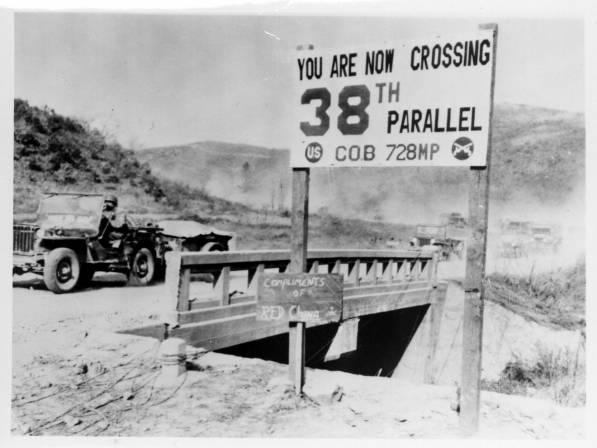
Task
Your task for this Webquest will be to work with your partner to...
- Read through your assigned documents.
- Use a Venn Diagram to compare and contrast the United States' response to the rise of Communisim in Korea to the U.S. justification for actions in the Middle East in the 21st Century.
- Aruge for or against U.S. intervention in the Korean War. You must be able to support your position with evidence from the documents and sources provided in the Webquest!
Process
Navigate through the documents below.
Note: Many of the documents have more than 1 page. Be sure to use the navigation arrows below the images to advance through the documents!
Student A:
Document 1: War Department Incoming Classified Message, Sept. 1945
Document 2: War Department Incoming Classified Message, Oct., 1945
Document 3: Telegram from Kim Koo to Truman, Jan. 1947
Document 4: Memo to Truman, June 1949
Document 5: Truce Agreement, 1953
Student B:
Document 1: Bush Statement demanding Hussein & Sons leave Iraq, Mar. 2003
Document 2: BBC Timeline of Iraq War
Evaluation
Your work will be evaluated in the following way (Total of 25 points):
Did you spend most of your time in class on-task? (5 points possible)
Did you cooperate fully with your partner? (5 points possible)
Did you complete a Venn Diagram with a minimum of 3 points per category? (10 points possible)
Did you write 1 paragraph arguing for or against U.S. involvement in Korea? (10 points possible)
Conclusion
History has a habit of repeating itself. As you saw through these documents, the U.S. tends to have very similar rationales for its involvement in foreign affairs.
Credits
Resources from:
Truman Library.org
Archives.gov
BBC
NY Times