
Introduction
"My wealth has come from a combination of living in America, some lucky genes, and compound interest."(Warren Buffett, 2010) How does it happen? What is compound interest, and how does it work? In this quest, we'll take a look at the compound interest formula in more depth, go through examples that can help you calculate the interest rate and time factor, and incorporate additional regular contributions.
Task
In this lesson, you are expected to:
- compute interest, maturity value, and present value in compound interest, and
- solve problem involving compound interest
Process
What Is Compound Interest?
Compound interest (or compounding interest)is thought to have originated in 17th-century Italy. It is the interest earn on a balance in a savings or investing account is reinvested, earning more interest. As a wise man once said, “Money makes money. And the money that money makes, makes money.”
Compound interest accelerates the growth of savings and investments over time. Conversely, it also expands the debt balances owe over time. It's what Albert Einstein allegedly called the eighth wonder of the world.
Simple Interest vs. Compound Interest
Simple interest works differently than compound interest. Simple interest is calculated based only on the principal amount. Earned interest is not compounded—or reinvested into the principal—when calculating simple interest.
Thinking in terms of simple interest, that $1,000 account balance that earns 5% annual interest would pay you $50 a year, period. The earned interest would not be added back into the principal. In year two, you’d earn another $50.
Simple interest is commonly used to calculate the interest charged on car loans and other forms of shorter-term consumer loans. Meanwhile, interest changed on credit card debt compounds—and that’s exactly why it feels like credit card debt can get so large, so quickly.
In an ideal world, you’d want your savings and investments to be calculated with compound interest—and your debts to be calculated with simple interest.
Key Compound Interest Variables
When calculating compound interest, you need to understand a few key factors. Each plays its own role in the end product, and some variables can drastically impact your returns. Here are the five key variables involved in understanding compound interest:
- Interest. This is the interest rate earn or are charged. The higher the interest rate, the more money you earn or the more money you owe.
- Starting principal. How much money are you starting with? How big a loan did you take out? While compounding adds up over time, it’s all based on the initial amount you deposit or borrow.
- Frequency of compounding. The pace at which interest is compounded—daily, monthly or annually—determines how rapidly a balance grows. When taking out a loan or opening a savings account, make sure you understand how often interest compounds.
- Duration. How long do you anticipate owning an account or paying off a loan? The longer you leave money in a savings account or the longer you hold on to a debt, the longer it has to compound and the more you’ll earn—or owe.
- Deposits and withdrawals. Do you anticipate making regular deposits into your account? How often will you make loan payments? The pace at which you build up your principal balance or pay down your loan makes a big difference over the long run.
Compound Interest Formula
There are a few ways to calculate compound interest.
Here’s the compound interest formula:
|
P = principal amount (the initial amount you borrow or deposit) r = annual rate of interest (as a decimal) t = number of years the amount is deposited or borrowed for. A = amount of money accumulated after n years, including interest. n = number of times the interest is compounded per year |
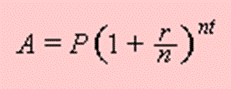
It’s important to note that the annual interest rate is divided by the number of times it’s compounded a year. This gives you the daily, monthly or annual average interest rate, depending on compounding frequency.
How to use the compound interest formula
To use the compound interest formula you will need figures for principal amount, annual interest rate, time factor and the number of compound periods. Once you have those, you can go through the process of calculating compound interest.
Here’s how that plays out with numbers: Let’s say Ada put Php.5,000 into a savings account paying 5% interest. The account is compounded monthly for 10 years. In this situation, you know P (5,000), r (.05), n (12), and t (10). Now, let’s put those in the compound interest formula.
- A = P (1 + [r / n]) ^ nt
- A = 5,000 (1 + [.05 / 12]) ^ (12 * 10)
- A = 5,000 (1.00417) ^ (120)
- A = 5,000 (1.64767)
- A = 8,238.35
In 10 years, you’d have about Php.8,238 in the account. That includes your Php.5,000 initial deposit and Php.3,238 in interest. In this case the unknown is the Future or accumulated amount. What if the unknown is the Principal amount, Time or Rate? What Formula is needed? Good thing that you can use this one formula in finding these variables.
Evaluation
It's Your Turn!
1.If P 450,000 is invested for 9 years at 10% compounded quarterly, find
a. The compound interest
b. The compound amount
2. On his eighteenth birthday, Chimmy received P250,000, the sum of which was the result of an investment made by his father on the day that he was born. How large was the investment if it earned interest at 14% compounded quarterly?
3.How long will it take for P10,000 to accumulate to P13,000 if the interest is 12% compounded quarterly?
4. If you invested P11,000 at 6% compounded monthly, how long will it take the account to double the money?
Conclusion
The Bottom Line
Compound interest and compounding can supercharge your savings and retirement potential. Successful compounding lets you use less of your own money to reach your goals. However, compounding can also work against you, like when high-interest credit card debt builds on itself over time. That’s why compounding is a powerful motivator to pay off your debts as soon as you can and start investing and saving your money early.
Credits
Compound Interest Formula video retrieve from:
Compound Interest Formula from:
https://www.thecalculatorsite.com/articles/finance/compound-interest-fo….
Compounding is the Eighth Wonder of the World video retrieve from:
Finding the Principal Amount in Compound Interest retrieve from:
Finding the Time in Compound Interest retrieve from:
Finding the Rate in Compound Interest retrieve from: