
Introduction
What is Piaget's Theory of Cognitive Development?
The Theory of Cognitive Development by Jean Piaget, the Swiss psychologist, suggests that children's intelligence undergoes changes as they grow. Cognitive development in children is not only related to acquiring knowledge, children need to build or develop a mental model of their surrounding world (Miller, 2011). His work is regarded as the cornerstone in the field of developmental psychology.
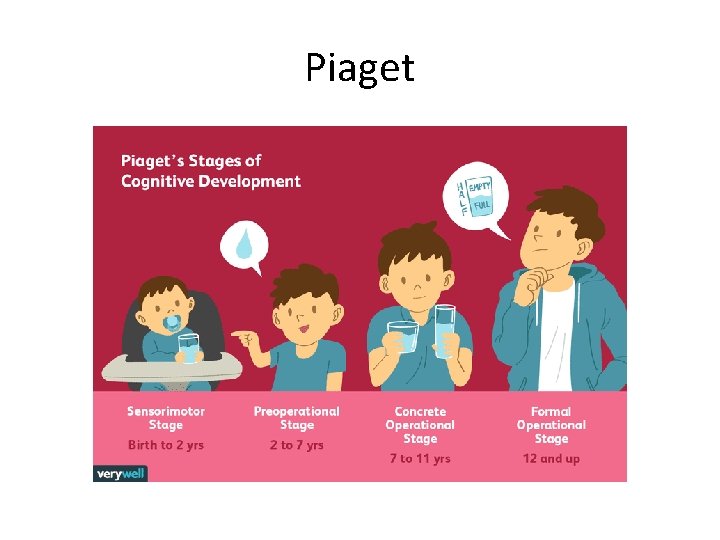
Jean Piaget's theory of cognitive development suggests that children move through four different stages of learning. His theory focuses not only on understanding how children acquire knowledge, but also on understanding the nature of intelligence. Piaget's stages are:
- Sensorimotor stage: Birth to 2 years
- Preoperational stage: Ages 2 to 7
- Concrete operational stage: Ages 7 to 11
- Formal operational stage: Ages 12 and up
Piaget proposed that intelligence grows and develops through a series of stages. Older children do not just think more quickly than younger children. Instead, there are both qualitative and quantitative differences between the thinking of young children versus older children. Based on his observations, he concluded that children were not less intelligent than adults—they simply think differently. Albert Einstein called Piaget's discovery "so simple only a genius could have thought of it."
Piaget's stage theory describes the cognitive development of children. Cognitive development involves changes in cognitive process and abilities. In Piaget's view, early cognitive development involves processes based upon actions and later progresses to changes in mental operations.
NOW PROCEED TO TASK PAGE
Task
TASK: GRAVITY EXPERIMENT
Piaget theorized that children in the concrete stage of development are active and curious. Incorporating hands-on activities in which students can experiment with objects will help them begin to make observations and understand multiple aspects of how things work. Hands-on activities such as science experiments and crafting can help students discover the meanings of concepts using their previous knowledge and logical thought.
You will be given chance to use scientific principles by giving them a simple physical experiment to perform and write about in a report. You must develop a principle based on experimentation and compare their results to that of scientists who have come before you. One simple idea is to have students drop objects of different masses at the same time from the same height to determine which objects fall faster. You will form a hypothesis, a guess, as to what will happen prior to the actual experiment, have them perform a series of tests, record your findings and finally to write a lab report that includes your hypothesis, their process of experimentation, results and conclusions based on these results.
NOW PROCEED TO PROCESS PAGE
Process
PROCESS
This experiment requires the following:
- A sturdy chair
- Stopwatch
- Balloon
- Various classroom items
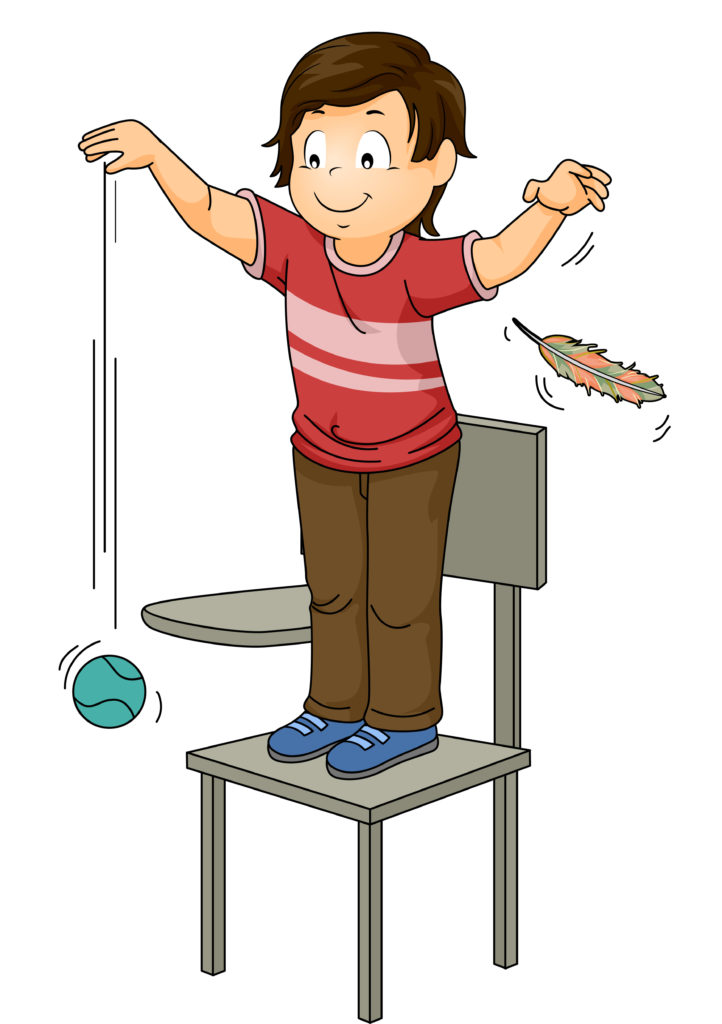
1. Gather items of differing weights and sizes, such as a chalk, scratched paper, crayon, and a balloon. Stand on top of the chair while holding the items. One at a time, drop each item from the same height. Keep track of how long it takes each item to reach the ground.
2. Form a hypothesis, a guess, as to what will happen prior to the actual experiment, have them perform a series of tests, record your findings and finally to write a lab report that includes your hypothesis, their process of experimentation, results and conclusions based on these results.
Though many believe that larger, heavier items will hit the ground first, this is not true. The rate of Earth’s gravitational pull on all objects is the same regardless of weight. Given the absence of air resistance, each object should reach the floor at the same time. Do your finding support this?

Evaluation
EVALUATION
This is how your work will be evaluated.
| 4 | 3 | 2 | 1 | SCORE | |
| Introduction |
Well written introduction including details of terms, some evidence of how they relate to project. |
Somewhat well written, missing some details. | Does not describe terms includes any information that should have been included in data. | Missing | |
| Problem statement | Clearly written includes a sentence which lists the independent and dependent variables for the problems the experiment is trying to solve. | Does not include list of variables which were controlled. | Poorly written, does not match | Limited | |
| Method | A numbered list of clear replicable steps detailing the method matches problem statement. | Method somewhat replicable, could be clearer. | Missing some steps and variables. | Missing more steps | |
| Data | Appropriate graphs charts. | Missing data or graph | Missing both data and Er | Could be hired for a phony news channel | |
| Conclusion | Conclusion well written and supported by specific examples of data. Well written discussion of validity including specific examples to explain why determine of acceleration is too high or low. | Conclusion somewhat supported by data, lack of specific examples. Some discussion of validity. | No use of specific data to support conclusion, no discussion of validity. | Time to take up astrology. |
Conclusion
CONCLUSION
WOW! Congratulations. You did well in the experiment and were able to guide your classmates and yourself toward new understandings. You may enhance your resourcefulness by carrying out these kinds of experiments, especially your goal-setting, planning, and problem-solving abilities. Additionally, it fosters your intellectual curiosity by assisting you in learning new techniques for posing queries and comprehending the outside environment.
I hope this experiment has been fun for you, has provided some personal growth opportunities for you, and has taught you a few new things.
-Ms. Bello
Credits
Credits should be given to the following:
www.structural-learning.com/post/jean-piagets-theory-of-cognitive-devel…
www.verywellmind.com/piagets-stages-of-cognitive-development
www. classroom-piagets-theory-cognitive-development
Teacher Page
TEACHER INTRODUCTION
The purpose of this WebQuest is to encourage students to think critically by analyzing, creating, and evaluating. Additionally, it promotes collaborative learning and integrates technology into education.
The cognitive developmental theory aids in our understanding of learning. As a result, students are better prepared to acquire problem-solving abilities that they can use later to consider complex circumstances. The ability to completely realize the cognitive, emotional, physical, social, and educational development that children go through from infancy until early adulthood is another reason why knowing the cognitive developmental theory is crucial.
The goal of this WebQuest is to introduce students to a new level of challenge and experience. To offer fresh concepts or to explain perplexing elements of subjects that students frequently struggle with. Students can take ownership of the new concept and utilize it to facilitate learning if the experiment's results are unexpected but convincing. Hands-on activities like science experiments can assist students learn the meanings of concepts utilizing their prior knowledge and logical thought in relation to the lesson on cognitive developmental theories.