
Introduction

Well...as you can see we have a BIG problem! Poncho is fat and lazy and getting fatter and lazier every day. He has made it known that he would like to be transported to his food dish from now on, since he has better things to do...
LIKE LAZING AROUND DOING NOTHING!
You will be designing and creating a prototype transport system to roll Poncho to his food dish.
Task

Your mission is to work as a team (2-3 people) to design and build a prototype "Poncho Transportation System", or PTS for short. Your PTS vehicle must travel forward at least 1.5 meters by pushing backward on the floor, the air, or some other object while carrying 150 grams of mass (Yes, I know...Poncho is much more massive than this, but remember, this is a PROTOtype design...a model of the real thing to come!!).
This is also called a "Newton Car".
Okay, I know what you’re thinking, “What is a Newton Car?”
A Newton Car is a vehicle that demonstrates Newton’s laws of motion, specifically Newton's 3rd Law of Motion.
Your team of engineers will demonstrate your vehicle to the class and explain its features, what you learned by changing your design, and how Newton's Laws affected your vehicle.
You will then participate in a class competition in which awards will be given to the fastest vehicle, the vehicle that can travel the farthest distance, and the vehicle that shows the greatest creativity.
Project Goals: This project will help you gain a better understanding of Newton’s Laws of Motion, friction, inertia, speed, acceleration, momentum, and force. The project will also help you hone your problem-solving and engineering skills.
Process
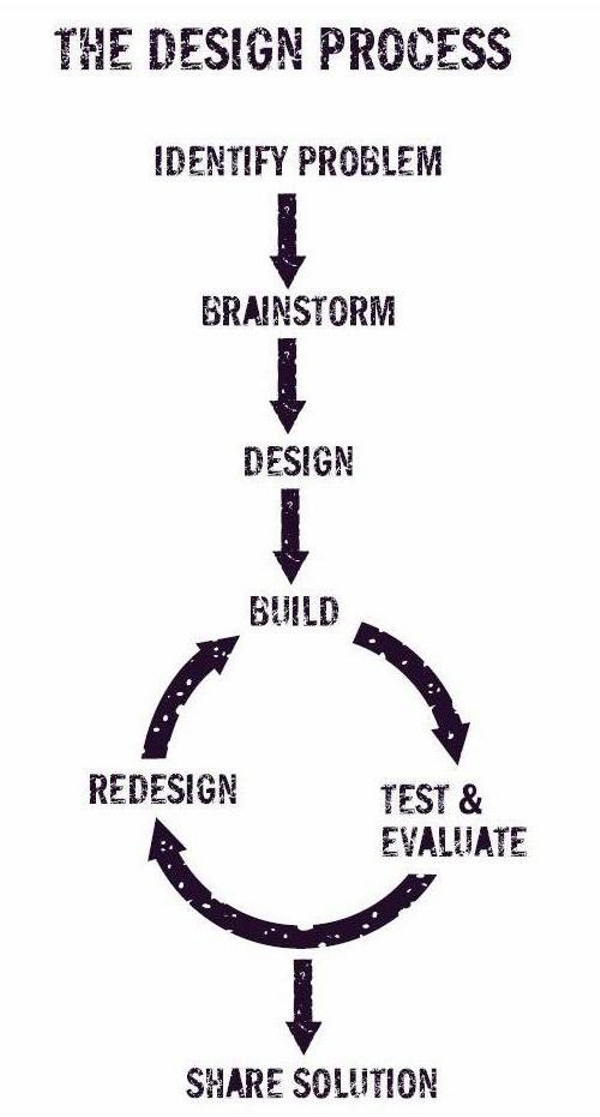
This is an engineering project.
Keeping good records of each step of the design process is very important...you want to be able to go back and refer to your notes about what you were thinking, what you did, what your million-dollar ideas were, etc....at any time!
Let's face it...sometimes the teenage brain doesn't cooperate very well. You may have the best of intentions of remembering everything...but don't be fooled! WRITE EVERYTHING DOWN!!!
You will need to complete the following steps (details given below):
1. Brainstorm/Conduct Research
2. Plan and Design
3. Construct/Build
4. Test, Collect Data, Analyze, Adjust and Improve
5. Communicate Your Process and Solution
6. Compete!
Project Time Line:
Class Days 1-2: Familiarize yourself with the requirements of the project. Brainstorm!! Work with your team and come up with sketches of possible vehicles. Conduct your research and complete your "PTS Research Packet" (see "Research" section below for details). Decide upon and collect materials.
Class Days 3-4 : Begin construction. Continue to check to make sure you are satisfying the requirements of the project. Start discussing and making your poster that you will present to the class. See below for details.
Class Days 4 -5: Continue building with your team. Test your vehicle on the class track. Collect data. Modify your vehicle and test again. Even if it performs as expected, attempt an improvement and test again. Your team needs at least 2 designs. Meet with your team to work on and complete your poster.
Class Day 6: Present your vehicle to your class. Prove it meets the minimum requirements.
Class Day 7: Compete! Prizes awarded for fastests, longest traveling, and most creative cars!
1. Research
I know you're itchin' to get started, but before you can begin designing the car, you must gain a fundamental understanding of the physics of motion. Seriously children (I mean young adults), it has been my experience that the best Newton Cars are built by teams that do the best research.
Have your teacher (that's me) check your progress as you complete each section. Then meet with another team in the class to compare answers and make necessary revisions. Don't compare notes until you have made a valiant attempt on your own! I'll be watching! And grading...
(NOTE: This research packet has its own grade separate from the rest of the project!! Yes - it's THAT important!)
CLICK HERE to access the PTS RESEARCH PACKET.
2. Plan and Design - Project Rules:
- Your vehicle must use Newton’s third law of motion to move-- it must move forward by pushing backward somehow on the floor, the air, or some other object. You cannot push your vehicle, or use any form of electricity, fossil fuels, combustion, a propeller or a ramp.
-Your vehicle must travel a minimum of 1.5 meters and completely cross the finish line while carrying a mass of 150 grams.
-The car must have a minimum of three wheels.
-Your vehicle needs to be hand built from everyday materials - NO PREMADE KITS ALLOWED!! For construction advice, see the "Construction" section below.
-Vehicles need to be built in class.
-You will present your final design to the class and explain your process and experience. See below for details.
-You will also need to explain the modifications that you made to improve the performance of your vehicle, using your physics vocabulary, including how your vehicle’s mass affects the performance and design. See below for details.
Just a thought: “Form follows function”
If you think your Newton Car will work better in the shape of SpongeBob SquarePants, then go ahead and make it look like SpongeBob SquarePants, but don’t make it look like SpongeBob SquarePants just because you like SpongeBob SquarePants. Got it?
3. Construction
**NOTE: NO PRE-MADE KITS ALLOWED!! ALL VEHICLES MUST BE HAND-MADE FROM EVERYDAY MATERIALS, BE THE SOLE INVENTION OF THE ENGINEERING TEAM, AND BE MADE IN CLASS**
Suggested Materials:
1. Wheels –plastic bottle caps, cd’s, spools of thread; you may cut-out your own wheels from paper,plastic, Styrofoam, metal, etc…
2. Axle rod – The rod is the part attached to two wheels so they turn in unison. Small diameter plastic straws, coffee stirrers work well. You may cut them or use a material of your choice.
3. Axle housing – You slip the rod through the housing and attach the housing to the car. Regular plastic straws work well. They can be cut to any size you want.
4. Body – anything you want, popsicle stick, cardboard, styrofoam, balsa wood etc…I once saw a very successful Newton car made with an old shoe for a body (I think it was a size 6 Steve Madden gold metallic slip on, but whatever...) Hmmm...what will give the best results?
5. Power Source - Rubber bands, balloons, mousetraps, bungee cords...what else can you think of?
6. Various materials to construct the racers...all materials must be “stuff” lying around your house or school
If you need materials or ideas let me know and I will help you out.
Building the Car : Tips and Tricks
• The first thing to do is choose the material to build the body of the car. The body should be both light and sturdy. It is also important to design a body that is long enough. Make sure you design it so that it can carry a mass of 150 g. Short cars tend to spin out more often than longer ones. A good car should be about 30 cm long.
• The second thing to do is build and mount the wheels. Wheels can be made out of about anything that is round, such as CDs, caps, and lids. The hard part, however, is getting them mounted straight with little friction. If the wheels are not mounted straight or are not free to spin smoothly, the car will not perform. Also, making sure the axles are parallel is key.
• Once the wheels are mounted on the body it is time to figure out the power source for your car - how are you going to make it move?
• If the car has a sturdy but light body, free moving wheels and a good power supply, you are well on your way to being a PTS racer champion!!
Warning: Do not wait until the last minute to build your car! It takes more time than you think.
4. Test, Collect Data, Analyze, Adjust and Improve
Good engineers keep detailed records. Use the provided specification and data collection sheet to keep track of your progress. It is extremely important that you take careful notes of your trials so that you can document your work.
CLICK HERE for the Specification and Data Collection Sheet.
5. Communicate Your Process and Solution
Scientists and engineers communicate their findings and experiences with the world! You will do the same by presenting your project to your classmates. You will document your work and create a poster (on 14" x 17" paper - no bigger!! - I will provide this for you) and discuss it with your colleagues prior to our competition. I will be looking for your proper use of academic language during this presentation.
Key Vocabulary words to consider:
Speed
Acceleration
Friction (sliding,rolling,fluid,etc)
Forces(gravity,compression,tension,etc)
Mass
Momentum
Pulling
Pushing
Action/Reaction
Inertia
Distance
Time
Unbalanced forces
Any others??
CLICK HERE for the Poster Format you will use.
6. Compete!
Judging/Evaluation
Cars will be tested on a smooth flat surface. Distance is measured from the starting line to the farthest point of travel, utilizing a straight line to connect the two points.
Prizes!! will be given to the group with the fastest Newton Car, the group whose car travels the farthest, and the group with the most creative car.
Your final grade is based on a combination of your vehicle's performance, your presentation to the class, and your poster.
NOTE: A separate grade will be given for your initial research packet.
CLICK HERE for the final scoresheet.
- Can I use a fan to push the car along? No. The car must move forward by propelling an object backward. Of course if you can figure out how to make the car move forward by propelling an object forward, go for it.
- Can my car push against the wall or some other stationary object like the principal? Sorry, that’s cheating and it makes the principal very angry with me.
- How big can I make it? The Newton Car can be any size as long as it will fit through the door and not require the rental of a flatbed truck.
- Will I get extra credit for making it look real nice? Nope, but you might win a prize.
- Can I use rubber bands? Yes, you can use rubber bands but not to power a propeller or to shoot at other students during math class.
- What’s the meaning of life? You exist to take in nutrients (eat), expel waste products (poop), and eventually procreate (make more little creatures like you).
- What's your quest? To seek the Holy Grail.
- What’s your favorite color? Blue. No wait, it’s green. Maybe orange...
v\:* {behavior:url(#default#VML);}
o\:* {behavior:url(#default#VML);}
w\:* {behavior:url(#default#VML);}
.shape {behavior:url(#default#VML);}
Normal
0
false
false
false
MicrosoftInternetExplorer4
/* Style Definitions */
table.MsoNormalTable
{mso-style-name:"Table Normal";
mso-tstyle-rowband-size:0;
mso-tstyle-colband-size:0;
mso-style-noshow:yes;
mso-style-parent:"";
mso-padding-alt:0in 5.4pt 0in 5.4pt;
mso-para-margin:0in;
mso-para-margin-bottom:.0001pt;
mso-pagination:widow-orphan;
font-size:10.0pt;
font-family:"Times New Roman";
mso-ansi-language:#0400;
mso-fareast-language:#0400;
mso-bidi-language:#0400;}
Credits
CREDITS
Thanks Chubs! You have energizing ideas!
http://www.portlandschools.org/CTS/GrantsProjects/moulens/newtoncar/index.htm
Thanks to Daniel Bone, SAIL, USC and Mr. Hatten for inspiration and great ideas:
http://bela.usc.edu/pdfdocuments/Lesson%20plans/8th/NewtonsLawsVehicles_DBone.pdf.
http://www.mrhatten.com/8thGradeScience/Balloon%20Race%20Cars/BalloonPoweredRacecars%20Hatten.doc.
Also, thanks to my friends at La Entrada Middle School for encouraging me as I developed this project! Great colleagues make a difference.