
Introduction
The foundation of best practice teaching in early childhood education is Developmentally Appropriate Practice (DAP). This means understanding what children of a particular age typically can already do, and what they are likely to be able to do next. This research based knowledge is used to design and plan the learning space, activities, expectations of, and learning goals for each child.
According to the National Association for the Education of Young Children (NAEYC), 3 core considerations of Developmentally Appropriate Practice are*:
- Knowing about child development and learning
- Knowing what is individually appropriate
- Knowing what is culturally important
This webquest jigsaw activity will focus on the first element: Knowing about child development and learning
*Accessed from naeyc website: http://www.naeyc.org/DAP
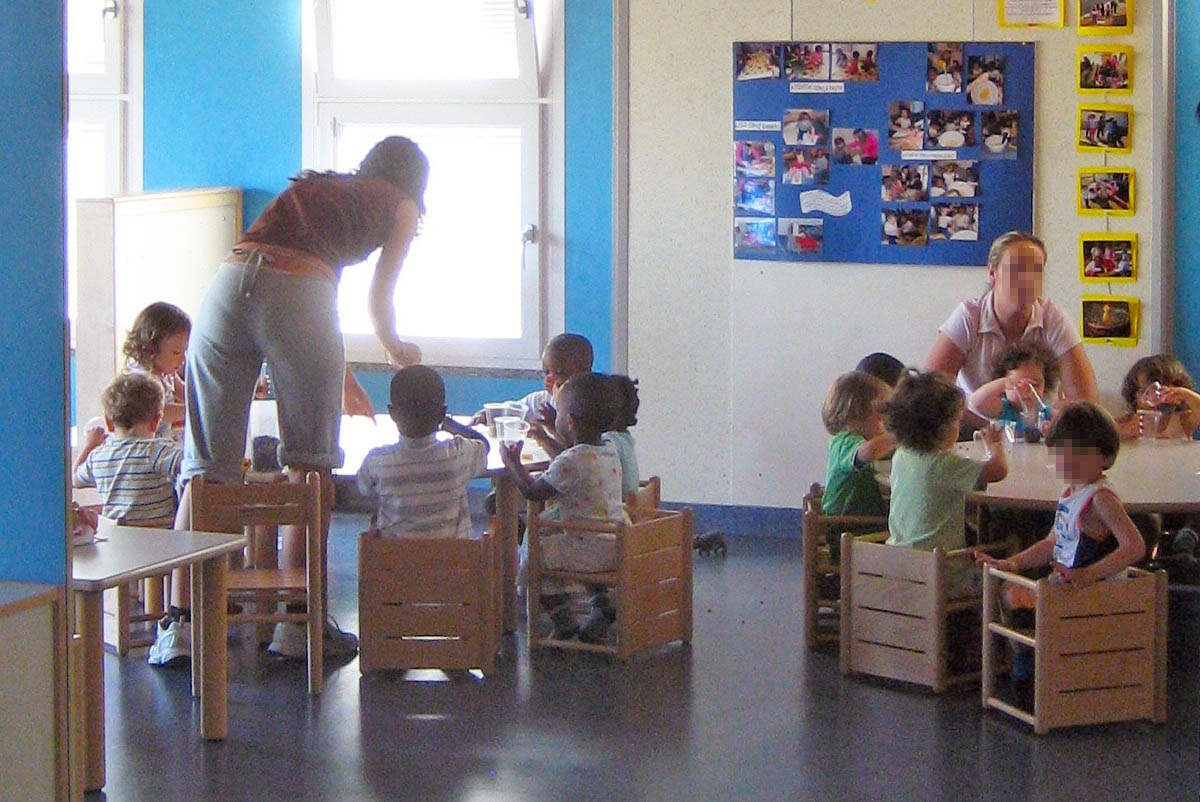
Photo accessed from: https://upload.wikimedia.org/wikipedia/commons/4/4d/Teachers_and_childr…

Task
This jigsaw activity will refresh and build your knowledge and understanding of childhood development.
Your task is to view videos and read articles about childhood development at a particular age range. Then in class, you will share the information you learned with others, and they willl share what they learned about their specific age group with you.
Tasks:
1. Day 1 in Face to Face (F2F) class: You will choose a specific age to research and discuss how to complete the project.
2. Hybrid online assignment 1: You will research the developmental milestones of your age group and complete the section of the childhood development table for your age group.
3. Day 2 in F2F class: You will come to class prepared to discuss what you have learned and bring the childhood development table completed for your age group. You will first work with others who have studied the same age group, then form a new group with one person from each of the age groups to share the information you have learned and apply your learning.
Process
Day 1 in F2F class: Introduction to the project, and choosing a specific age to research:
- Infants- birth to age 1
- Toddlers- ages 1 and 2
- Preschoolers- ages 3-5
- School Age- ages 5.5- 8
Hybrid online assignment 1:
- Research the developmental milestones of your age group- including intellectual, physical, social and emotional development. Complete the section of the childhood development table relating to your age group. Cite your sources
- See resources for your age group on this document: https://goo.gl/POImEJ
-
- Open the childhood Development Table, Click on this link: https://goo.gl/tEGskC , click on 'Use this template' in the upper right corner and change the name to: 'your first and last name-age group- Childhood Development' (ex. Lauren Lang- Toddlers - Childhood Development)
Day 2 in F2F class:
Come prepared to discuss what you have learned and bring completed section for your age group of the childhood development table.
GET IN AGE LEVEL GROUPS: You will meet with others who have studied the same age group.
Task 1: You will share what you have learned.
Task 2: As a group, you will come up with a one sentence summary of a child at your age group. (see rubric in the evaluation section)
FORM NEW GROUPS- with one person from each age level. (OR we will share as a whole group)
Take turns sharing both the sentence and information from the table relating to your age group. Each person will complete their entire table. Ask for clarification as needed to complete your table.
Evaluation
Rubric for Child Development Webquest Jigsaw
Individual Work:
1. Child Development Table Rubric
|
Complete |
Exemplary (10 possible points)
|
Average (9-5 possible points)
|
Needs Work (4-0 points)
|
|
Use of sources |
Exemplary (10- 9 possible points)
|
Average (8-5 possible points)
|
Needs Work (4-0 points)
|
|
Accurate |
Exemplary (10 possible points)
|
Average (9-5 possible points)
|
Needs Work (4-0 points)
|
Group Work:
3. Age Summary Statement Rubric
|
|
Exemplary 10-9 possible points |
Average 8-5 possible points |
Needs Work 2-0 possible points |
|
Complete |
(cognitive, emotional/social, physical, and communication/ language) (4-3 points possible) |
(4-2 points possible) |
(2-0 points possible) |
|
Accurate |
(4 points possible) |
(3-2 points possible) |
|
|
Correct Form |
(2 points possible) |
(1 point possible) |
(0 points possible) |