
Introduction
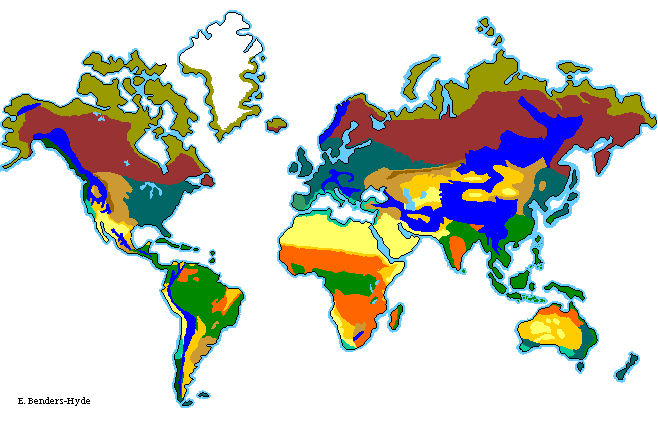
A travel agency is needing some major help. Business has gone way down and they are worried that they will have to close the agency. They have hired you, an ecologist, to help them research new places to visit. Your assignment is to research a biome (ecosystem) and report back to the agency.
The world is made up of many different ecosystems. Ecosystems are also called biomes. Each biome is unique in its animals, plants, and climate. Within these biomes, the living organisms have adaptations to help them survive in these sometimes extreme environments. From forests to deserts to chapparals to marine biomes, the world has them all. You are an ecologist who is researching the biomes of the world.
You will pick a biome to research. It is your challenge to find out as much as possible about your biome! You will complete a research sheet, a research paper, and a PowerPoint presentation to compliment your project. Some of you will also be doing a poster or diorama in your science class as well.
Now it is time to begin...
Task
Task 1 -
You must pick a biome to research. Your choices are:
- Desert
- Tundra
- Taiga (Coniferous Forest)
- Temperate Deciduous Forest
- Grassland
- Tropical Rain Forest
- Freshwater Marsh
- Ocean
Task 2 -
You must complete the research sheet provided to you by Mrs. Goodman. When you have completed your sheet, take it to Mrs. Goodman.
Task 3 -
You must write a research paper using the format that Mrs. Goodman has given to you. You will get a sheet for this after completing task 2.
Task 4 -
You must complete a PowerPoint following the instructions given to you by Mrs. Goodman. You will get another sheet for this once you finish task 3.
If you have completed all the tasks listed above and there is still time, you will complete an extra credit project by creating a travel brochure for your biome.
Process
Task 1 - First pick a Biome.
To complete task 2, you will need to get a research sheet from Mrs. Goodman.
To find the answers to the questions, visit the websites listed for each biome or use the library books in the basket.
Desert
http://www.desertanimals.net/
http://www.mbgnet.net/sets/desert/index.htm
http://www.windows.ucar.edu/tour/link=/earth/desert_eco.html&edu=elem
http://environment.nationalgeographic.com/environment/habitats/desert-profile/
http://www.blueplanetbiomes.org/desert.htm
http://wwf.panda.org/about_our_earth/ecoregions/about/habitat_types/habitats/deserts/
http://www.ucmp.berkeley.edu/glossary/gloss5/biome/deserts.html
Tundra
http://www.blueplanetbiomes.org/tundra.htm
http://mbgnet.mobot.org/sets/tundra/
http://www.panda.org/news_facts/education/virtual_wildlife/wild_places/polar_region.cfm
http://www.ucmp.berkeley.edu/exhibits/biomes/tundra.php
http://environment.nationalgeographic.com/environment/habitats/tundra-profile/
http://www.mrnussbaum.com/biomes.htm
http://kids.nceas.ucsb.edu/biomes/tundra.html
Taiga (Coniferous Forest)
http://www.blueplanetbiomes.org/taiga.htm
http://en.wikipedia.org/wiki/Taiga
http://www.enchantedlearning.com/biomes/taiga/taiga.shtml
http://mbgnet.mobot.org/sets/taiga/
http://www.panda.org/news_facts/education/virtual_wildlife/wild_places/coniferous_forests.cfm
http://kids.nceas.ucsb.edu/biomes/taiga.html
Temperate Deciduous Forest
http://www.mbgnet.net/sets/temp/index.htm
http://www.globio.org/glossopedia/article.aspx?art_id=3
http://kids.nceas.ucsb.edu/biomes/temperateforest.html
http://www.enchantedlearning.com/biomes/tempdecid/tempdecid.shtml
http://www.blueplanetbiomes.org/deciduous_forest.htm
http://www.panda.org/news_facts/education/virtual_wildlife/wild_places/temperate_forests.cfm
Grasslands
http://www.blueplanetbiomes.org/grasslands.htm
http://mbgnet.mobot.org/sets/grasslnd/index.htm
http://www.ucmp.berkeley.edu/glossary/gloss5/biome/grasslan.html
http://www.windows.ucar.edu/tour/link=/earth/grassland_eco.html&edu=elem
http://www.pbs.org/earthonedge/ecosystems/grasslands.html
http://www.ducksters.com/science/ecosystems/grasslands_biome.php
http://www.kidsgeo.com/geography-for-kids/0168-grassland-biomes.php
http://www.marietta.edu/~biol/biomes/grass.htm
Tropical Rain Foreset
http://www.blueplanetbiomes.org/rainforest.htm
http://www.panda.org/news_facts/education/virtual_wildlife/wild_places/tropical_forests.cfm
http://mbgnet.mobot.org/sets/rforest/
http://en.wikipedia.org/wiki/Rainforest
http://www.nature.org/rainforests/explore/facts.html
http://rainforestheroes.com/about-rainforests/rainforest-facts/
http://rainforestheroes.com/about-rainforests/what-is-a-rainforest-2/
http://www.windows2universe.org/earth/rainforest.html
Water Marsh
http://www.defenders.org/wetlands/types-wetlands
http://kids.nceas.ucsb.edu/biomes/freshwaterwetlands.html
http://education.nationalgeographic.com/education/encyclopedia/marsh/?ar_a=1
http://www.enchantedlearning.com/biomes/marsh/freshwater.shtml
http://yournec.org/content/kids-page-freshwater-ecosystems
http://bioexpedition.com/freshwater-biome/
http://www.ducksters.com/science/ecosystems/freshwater_biome.php
Ocean
http://www.focusonplanetearth.org/ecosystems/ecosystems-oceans.html
http://www.oceansforyouth.org/
http://kids.nceas.ucsb.edu/biomes/marine.html
http://www.ducksters.com/science/ecosystems/marine_biome.php
http://www.ehow.com/info_12071312_ocean-ecosystem-kids.html
http://www.earthskids.com/ek_science-marine.htm
Evaluation
Rubric for Research Project
|
Category
|
4
|
3
|
2
|
1
|
0
|
|
Research Sheet
|
The research sheet was completed with very good information and in a timely manner.
|
The research sheet was almost complete, had some good information, and completed in a timely manner
|
The research sheet had several items missing, very limited information, and/or wasn’t completed in a timely manner.
|
The research sheet had most items missing, had false information, and/or wasn’t at all completed in a timely manner.
|
No effort or didn’t complete any part of the sheet.
|
|
Research Paper – Paragraphs
|
The paper has at least 10 paragraphs.
|
The paper has 8-9 paragraphs.
|
The paper has 5 - 7 paragraphs.
|
The paper has 1– 4 paragraphs
|
The paper has no paragraphs.
|
|
Research Paper – Attractiveness
|
The paper is very neat, only has minor grammatical errors, and is typed according to the instructions.
|
The paper overall is neat, has a few grammatical errors, and is mostly typed according to the instructions.
|
The paper is somewhat neat, has several grammatical errors, and some of the paper is typed according to instructions.
|
The paper is messy, has major grammatical problems, and isn’t typed according to instructions.
|
The paper is not neat at all, major grammatical mistakes, and isn’t typed at all.
|
|
Research Paper – Sources
|
The paper has a sources page with at least three sources that are documented according to instructions.
|
The paper has a sources page with at least three sources that are somewhat documented according to instructions.
|
The paper has a sources page but only has two sources and/or they are not documented according to instructions.
|
The paper has a sources page with only one source and/or they are not documented according to instructions.
|
There is no sources page.
|
|
Research Paper – Time Management
|
The paper was done in a timely manner with plenty of time for editing and revisions.
|
The paper was done in a timely manner but needed a little more time for editing and revisions.
|
The paper took too long and there wasn’t any time for editing and revisions.
|
The paper wasn’t finished until the very last minute and still needed more work.
|
The paper wasn’t finished at all.
|
|
PowerPoint – Slides
|
The PP had at least 16 slides (15 + 1 for sources).
|
The PP had 13 – 16 slides (including one for sources).
|
The PP had 9 – 12 slides and/or was missing the sources slide.
|
The PP had fewer than 9 slides and was missing the sources slide.
|
There was no PP.
|
|
PowerPoint – Pictures and Attractiveness
|
The PP had at least 10 pictures and was attractive.
|
The PP had 7-9 pictures and was attractive.
|
The PP had 5-6 pictures and was somewhat attractive.
|
The PP had 2-4 pictures and was messy.
|
The PP didn’t have pictures and was messy.
|
Student completed the extra credit activity for an additional 10 points! ___________
Total Score _________________
Conclusion
Standards for Research Project --
English Language Arts
W.6.2. Write informative/explanatory texts to examine a topic and convey ideas, concepts, and information through the selection, organization, and analysis of relevant content. a. Introduce a topic; organize ideas, concepts, and information, using strategies such as definition, classification, comparison/contrast, and cause/effect; include formatting (e.g., headings), graphics (e.g., charts, tables), and multimedia when useful to aiding comprehension.
b. Develop the topic with relevant facts, definitions, concrete details, quotations, or other information and examples.
c. Use appropriate transitions to clarify the relationships among ideas and concepts.
d. Use precise language and domain-specific vocabulary to inform about or explain the topic.
e. Establish and maintain a formal style.
f. Provide a concluding statement or section that follows from the information or explanation presented.
W.6.4. Produce clear and coherent writing in which the development, organization, and style are appropriate to task, purpose, and audience. (Grade-specific expectations for writing types are defined in standards 1-3 above.)
W.6.5. With some guidance and support from peers and adults, develop and strengthen writing as needed by planning, revising, editing, rewriting, or trying a new approach. (Editing for conventions should demonstrate command of Language standards 1-3 up to and including grade 6 on page 53.)
W.6.6. Use technology, including the Internet, to produce and publish writing as well as to interact and collaborate with others; demonstrate sufficient command of keyboarding skills to type a minimum of three pages in a single sitting.
W.6.7. Conduct short research projects to answer a question, drawing on several sources and refocusing the inquiry when appropriate.
W.6.8. Gather relevant information from multiple print and digital sources; assess the credibility of each source; and quote or paraphrase the data and conclusions of others while avoiding plagiarism and providing basic bibliographic information for sources.
W.6.9. Draw evidence from literary or informational texts to support analysis, reflection, and research.
Science
SPI 0607.2.1 Classify organisms as producers, consumers, scavengers, or decomposers according to their role in a food chain or food web.
SPI 0607.2.2 Interpret how materials and energy are transferred through an ecosystem.
SPI 0607.2.3 Identify the biotic and abiotic elements of the major biomes.
SPI 0607.2.4 Identify the environmental conditions and interdependencies among organisms found in the major biomes.
Credits
This webquest was created by:
Cindy Goodman
Westhills Elementary School
Lewisburg, Tennessee
Teacher Page
Research Worksheet -
Biome Research Questions
What is your chosen biome? ______________________________________________________
Why did you select this biome? ____________________________________________________
___________________________________________________________________________________
What is the weather like in your biome? ____________________________________________
___________________________________________________________________________________
How much precipitation does your biome receive annually? ________________________
___________________________________________________________________________________
Where, in general, can your biome be found? ______________________________________
___________________________________________________________________________________
What was the most interesting fact you found out about your biome? _______________ ___________________________________________________________________________________
List 3 biotic and 3 abiotic items in this biome
Biotic - ____________________________________________________________________________
Abiotic - __________________________________________________________________________
List and describe at least three animals that live your chosen biome. Include the animal’s classification (consumer, scavenger, or decomposer), a physical description of that animal (use descriptive adjectives), what the animal eats, and why that animal lives in the biome you selected. Include at least one other interesting fact about each animal as well. If you wish to describe additional animals, please do so in your own handwriting on a loose leaf sheet of notebook paper and attach it to this page.
| Animal Name | Classification consumer, scavenger, or decomposer | Physical Description | Animal’s Diet | Reason for Living in This Biome | Interesting Fact |
|
|
|
|
|
|
|
|
|
|
|
|
|
|
|
|
|
|
|
|
|
List and describe at least four plants that live in your chosen biome. Include the plant’s classification (this should be easy – they are all producers J), a physical description of that plant (use descriptive adjectives), and why that plant lives in the biome you selected. Include at least one other interesting fact about each plant as well. If you wish to describe additional plants, please do so in your own handwriting on a loose leaf sheet of notebook paper and attach it to this page.
| Plant Name | Classification Producer | Physical Description | Reason for Living in this Biome | Interesting Fact |
|
|
|
|
|
|
|
|
|
|
|
|
|
|
|
|
|
|
|
|
|
|
|
|
What sources did you use to locate your information?
Source 1 – Title: ____________________________________________________________________
Author: ____________________________________________________________________________
Source Type (Website, library, textbook): _____________________________________________
Web address if applicable: _________________________________________________________
Source 2 – Title: ____________________________________________________________________
Author: ____________________________________________________________________________
Source Type (Website, library, textbook): _____________________________________________
Web address if applicable: _________________________________________________________
Source 3 – Title: ____________________________________________________________________
Author: ____________________________________________________________________________
Source Type (Website, library, textbook): _____________________________________________
Web address if applicable: _________________________________________________________