
Introduction
Castles had a major role in the Middle Ages. In this WebQeust you will learn about castle characteristics, their importance, what they provided, and who they provided for.
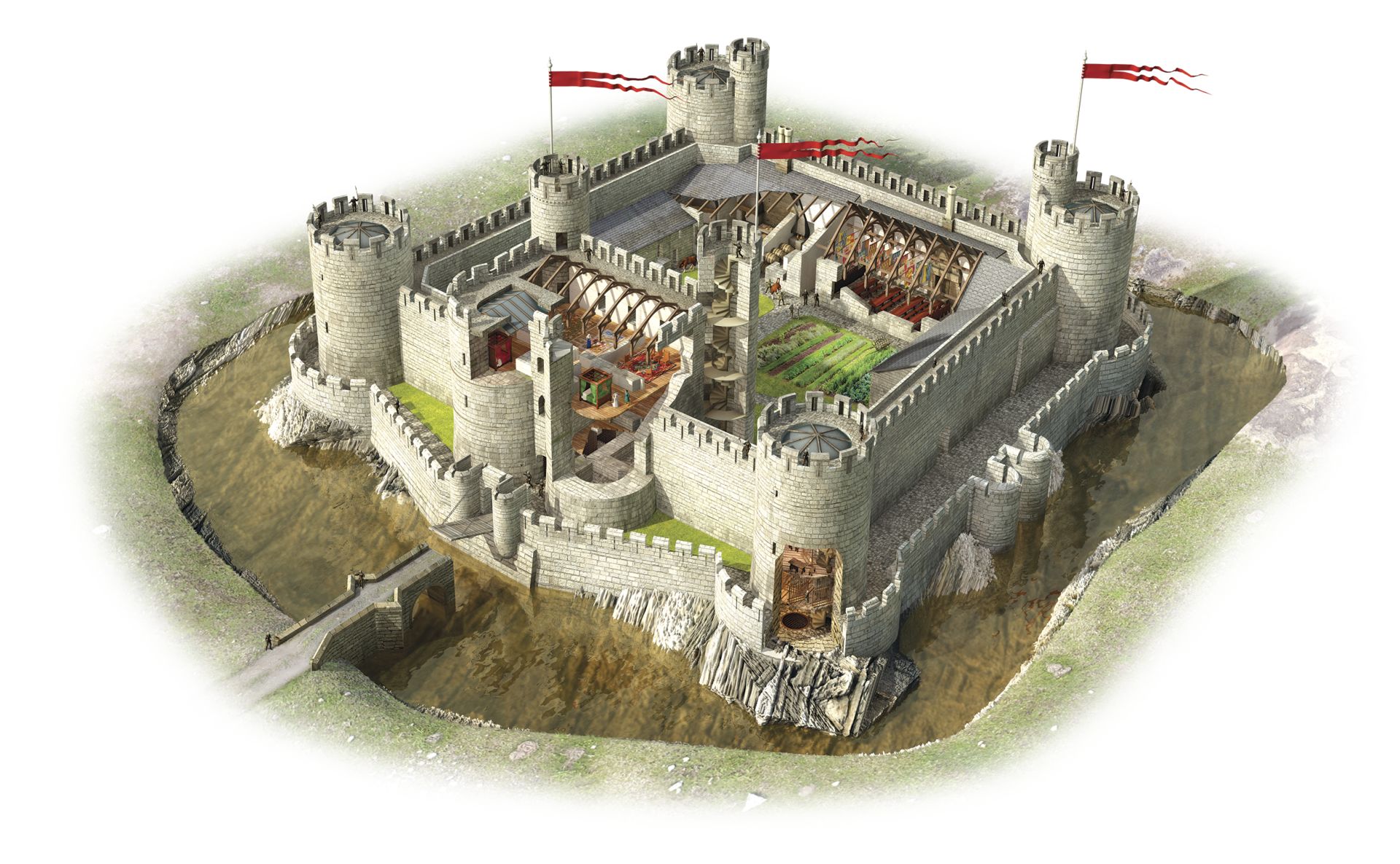
https://res.cloudinary.com/dk-find-out/image/upload/q_80,w_1920,f_auto/Castle_qgjlkh.jpg
Task
You will be researching castles from the Middle Ages and then creating your own castle. You will present your castle to the class as well as some of the knowledge you have found.
Process
Make sure you have completed these tasks first:
- Met with your group and written your background knowledge on feudalism.
- Written the questions you have about castles and the feudal system.
- Visit the sites below and review the pictures to learn more about castles.
- Write/type anything interesting you learn about feudalism and castles (at least 3 things) to share with the class.
- Also write down any answers you find to the questions you wrote in the "what I want to know" section of your KWL chart.
- Build your own castle!
- You can use any of the materials in the classroom to construct your castle. Keep in mind who lived there and why castles were important when you are building.
- How does your castle represent the castles in the middle ages?
- How are they alike? How are they different?
- Use the Castle book and any of the resources on this page for inspiration and ideas.
- You can use any of the materials in the classroom to construct your castle. Keep in mind who lived there and why castles were important when you are building.
- Present your castle and three new/interesting facts.
Cites for research:
https://www.playgroundequipment.com/castles-of-the-middle-ages/
https://www.ducksters.com/history/middle_ages_castles.php
https://www.dkfindout.com/us/history/castles/
https://kids.britannica.com/kids/article/feudalism/353125
https://kids.kiddle.co/Feudalism
Video on Feudalism:

Evaluation
Rubric:
|
Category |
10 |
8 |
4 |
|
Required Elements |
The project includes all required elements (written portion and physical model) and may provide additional information. |
The project is missing 1 required element. |
Several required elements were missing. |
|
Attractiveness |
The project is exceptionally attractive in terms of design, layout, and neatness. |
The project is acceptable in terms of design, layout and neatness. |
The project is distractingly messy or poorly designed. |
|
3 Facts |
Includes 3 interesting facts full of detail and information. |
Includes 3 interesting facts. |
Includes 2 or less interesting facts. |
|
Class Time Management |
Used time well during each class period. Focused on getting the project done. Never distracted others. |
Used some of the time well during each class period. There was some focus on getting the project done but occasionally distracted others. |
Did not use class time to focus on the project OR often distracted others. |
|
Collaboration |
Worked respectfully and cooperatively with group members. Work was equally distributed and allowed each member to add a creative element. |
Worked respectively with group members. The work was mostly distributed evenly, however there were some issues that arose. Individual ideas were not Included. |
Did not work respectively and or cooperatively with group members. Work was not evenly distributed, and no individual ideas or creative elements were included. |
TOTAL SCORE: __________/50
Conclusion
The Feudal system relied on castles and the people of the kingdom for protection, goods, and services. You learned about lords, nobles, serfs, and other key members of the Feudal system. Many castles are still around today; some can be toured, and some are still lived in.
Did you learn anything interesting from another group?
Would you want to live in a Middle Ages castle? Why/why not?
Answer these questions as self-reflection and write down any questions you still have about Feudalism or castles.
Teacher Page
|
Indiana P-12 Academic Standards and Indicators Addressed by this Lesson: |
Social Studies:
6.1.4 Identify and explain the development and organization of political, cultural, social and economic systems in Europe and the Americas. ● Examples: Feudal system, manorial system, rise of kingdoms and empires, and religious institutions
Art: VA:Cr1.1.6a: Combine concepts collaboratively to generate innovative ideas for creating art.
|