
Introduction
Congratulations, you have just gotten your certificate to become an official astronaut. You will be going and exploring various planents around our solar system to understand the differences between them.

Your Next objective is report to the task session to find the locations you will be studying. Have a safe trip on the spacecraft I am sure after all your training your ready to actually be in space. GoodLuck!
Task
There is a lot of exploring to do, so lets get started. Once we gather all the data and information
we need you are to design the solar system in three-dimmensional model or two dimmensional
model. Showing and listing all the knowledge aquired on this trip. You then are to present this to
the rest of the astronauts and the commanding officier to ensure you did a good job. Move on to
the Process section to find the steps that are needed to be taken to obatin the information.
Process
Make sure to take out a piece of answer to record your answers while investigating.
Here are the steps ordered to be looked into :
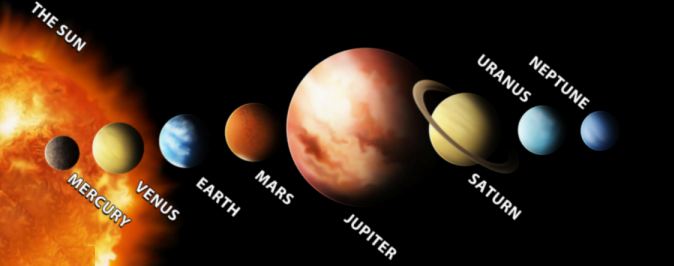
1.) How many planets are there and what is the order in which they are located from the sun? Go to.
2.) Investigate what makes the planets have different colors? Use this link.
http://coolcosmos.ipac.caltech.edu/ask/203-Why-do-the-planets-have-different-colors-
3.) Would you categorize Pluto as a planet? Explain why or why not.
http://history1900s.about.com/od/1930s/qt/Pluto.htm
4.) Please assess the climates and record unique facts about only planets we consider today.
http://www.kidsastronomy.com/the_planets.htm
Look to the Evaluation page to see my expectations.
Evaluation
This is the evaluation for the final product (poster or 3-D model).
I also expect Questions to be in complete sentences and accurately answered.
| CATEGORY | 4 | 3 | 2 | 1 |
| Graphics -Clarity | Graphics are all in focus and the content easily viewed and identified from 6 ft. away. | Most graphics are in focus and the content easily viewed and identified from 6 ft. away. | Most graphics are in focus and the content is easily viewed and identified from 4 ft. away. | Many graphics are not clear or are too small. |
| Content - Accuracy | At least 4 accurate facts are displayed on the poster. | 3 accurate facts are displayed on the poster. | 1-2 accurate facts are displayed on the poster. | 0 accurate facts are displayed on the poster. |
| Attractiveness | The poster or model is exceptionally attractive in terms of design, layout, and neatness. | The poster or model is attractive in terms of design, layout and neatness. | The poster or model is acceptably attractive though it may be a bit messy. | The poster or model is distractingly messy or very poorly designed. It is not attractive. |
| Knowledge Gained | Student can accurately answer all questions related to facts in the poster and processes used to create the poster. | Student can accurately answer most questions related to facts in the poster and processes used to create the poster. | Student can accurately answer about 75% of questions related to facts in the poster and processes used to create the poster. | Student appears to have insufficient knowledge about the facts or processes used in the poster. |
| Grammar | There are no grammatical mistakes on the poster or model. | There is 1-2 grammatical mistake on the poster or model. | There are 3 grammatical mistakes on the poster or model. | There are more than 3 grammatical mistakes on the poster or model. |
Conclusion
In conclusion:
- You will have successfully traveled in space seeing and observing the planets in our solar system.
- You will have a paper that has all the questions answered out in detail that you could use on your final product.
- Your final product was to be a poster or three dimensional model of the system with some of the information you found easily found on it.
- I hope you had fun exploring space, because you now know what our solar system is like.
- Note: Be sure to go onto YouTube or other educational websites where you can take virtual tours through the planets and their climates.
Credits
All the sources I used to accomplish this webquest of exploring the planets:
http://coolcosmos.ipac.caltech.edu/ask/203-Why-do-the-planets-have-different-colors-
http://history1900s.about.com/od/1930s/qt/Pluto.htm
http://www.kidsastronomy.com/the_planets.htm