
Introduction
Photosynthetic Mechanisms of C3 Plants:
C3 plants go through a cycle called the Calvin-Benson Cycle. This is when carbon dioxide goes through chemical reactions to form carbohydrates. C3 reactions include the regeneration of the CO2-acceptor chemical substrate. Plants that have this mechanism are called C3 plants The first step of the Calvin-Benson Cycle is CO2 fixation. CO2 diffuses into the Stroma of a chloroplast and then ribulose-1, 5-biphosphate (RuBP) is joined to the carbon dioxide to produce a 6-carbon product. The 6-carbon product is split into 2- three carbon compounds. The three carbon compounds are activated by ATP by adding another phosphate forming 1,3-biophosphoglycerate. 1,3 Biophosphoglycerate is reduced by NADPH to create G3P (glyceraldehyde-3-phosphate). Ten of the G3P continue in a cycle to produce RuBP by ATP breaking down the G3Ps. Two G3P are used to make glucose.
Examples of C3 Plants:
Rice
Wheat
Barley
Rye
Oats
Photosynthetic Mechanisms of C4 Plants:
This mechanism occurs in two attached cells, mesophyll and bundle sheath cells in C4 plants. CO2 enters the mesophyll cells and is hydrated to produce bicarbonate ion (HCO3) and carbonic anhydrase (CA) as a catalyst in the cytoplasm. HCO3 reacts with the three-carbon acid phosphoenolpyruvate (PEP) to form oxaloacetate (OAA). The reaction is catalized by the carboxylating enzyme phosphoenolpyruvate carboxylase (PEPcase). OAA is a four-carbon product which is why it is called a C4 photosynthesis. OAA is reduced to malate and transported to bundle-sheath cells. The malate is used to regenerate PEP and for the supply of CO2 for the C3 cycle. CO2 is removed from malate and pyruvate is formed. Pyruvate goes to the mesophyll cells where is goes back to PEP. The freed CO2 goes to the C3 cycle where glucose is then produced again.
Examles of C4 Plants:
Corn
Sugarcane
Barnyard grass
Switchgrass
Crabgrass
Task
C3 Plant Photosynthetic Diagram

C4 Plant Photosynthetic Diagram
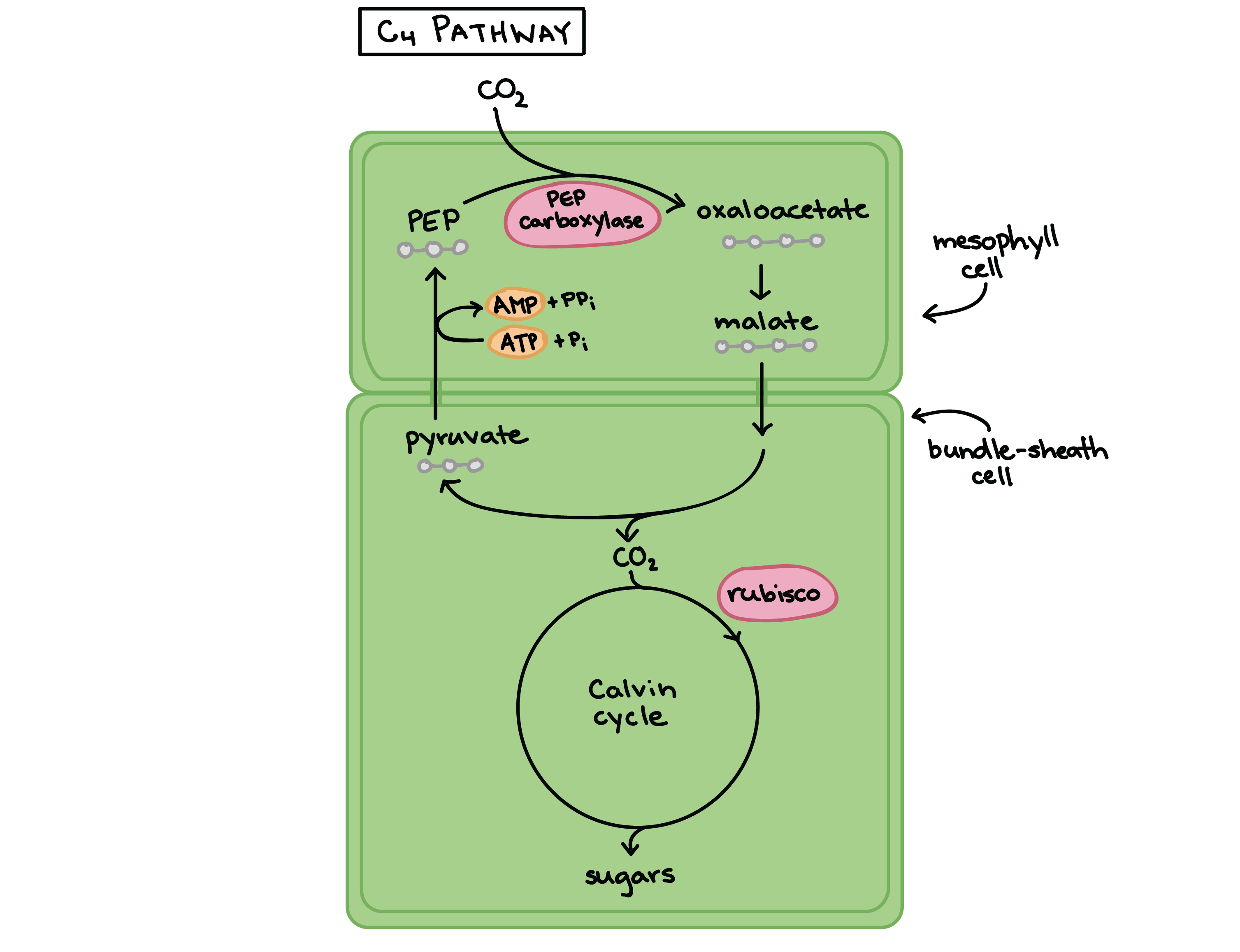
Process
Environmental Conditions of C3 Plants:
C3 plants are found in cool, wet environments. They are the most efficient and common in these locations. They also need just enough carbon dioxide to produce the maximum amount of sugars. C3 plants are the least effective in dry climates with high light exposure.
Environmental Conditions of C4 Plants:
C4 plants are found in hot, sunny and dry climates. They are the most effective in deserted areas and are adapted to avoid water loss. They are most commonly found in most grasslands in the tropics, subtropics and warm temperature zones.
Evaluation
Similarities and Differences Between C3 and C4 plants:
A similarity between theses processes is that they are both types of photosynthesis and use the same basic chemical formula. Another similarity is that they both use the Calvin-Benson Cycle. One difference between the two photosynthetic processes is that C3 plants need carbon dioxide, whereas C4 plants only need a limited amount. Another difference is C3 plants are the most common with making up 95% of plant population and C4 plants make up the remaining 5%.