
Introduction
Good day Students,
From the last class we had we spoke of production and the different kinds of industries and skills involved in the production process of a product. Below is a continuation of the topic on production and all the parties involved.
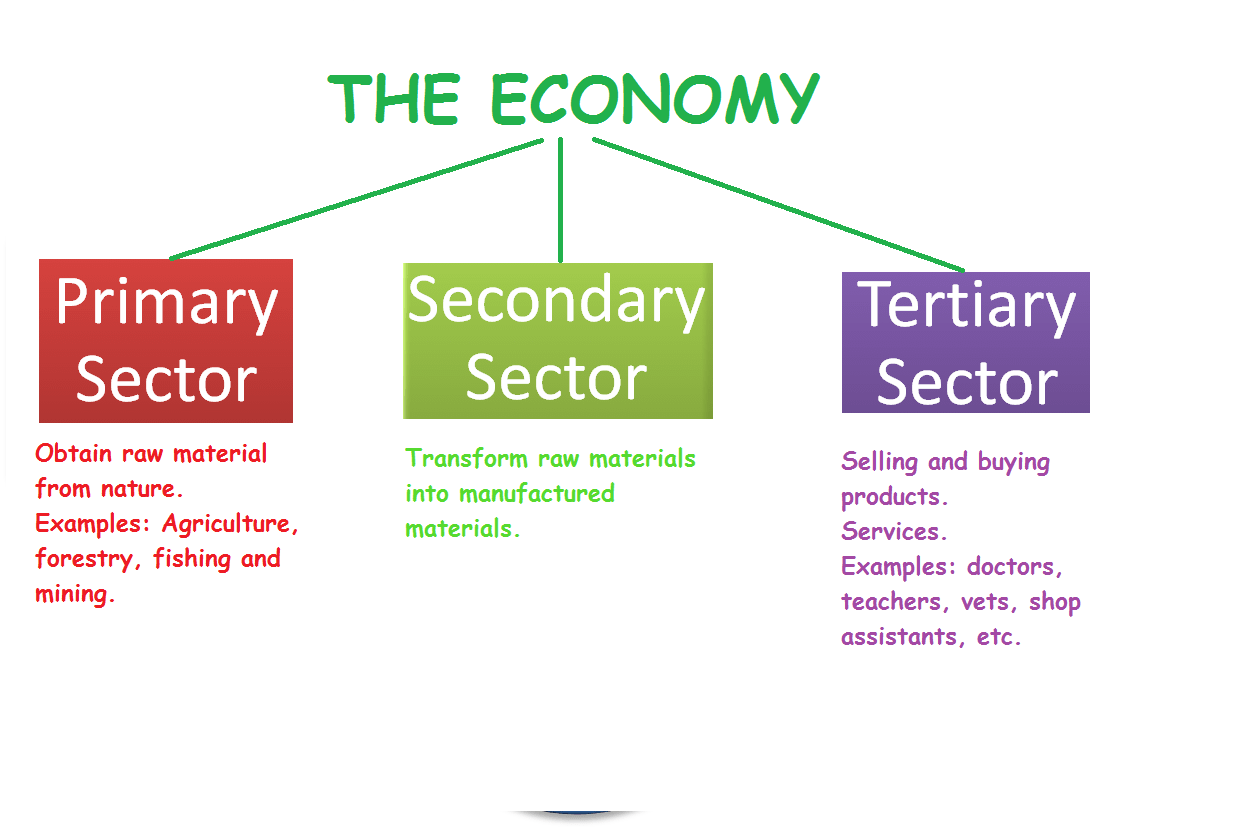
The economy is divided into three sectors namely, primary, secondary and tertiary sectors. Primary sector is responsible for the extraction nd cultivation of raw materials, whilst secondary sector is responsible for processing and manufacturing those raw materials into finished goods and services and the tertiary sector facilitates the flow of the goods and services from the primary and secondary sectors, and ensures that the good and services reach the customer.
Task
Business Studies assignment
Topic : Business sectors
Marks : 30
Due date : 31 May 2021
Question 1
1.1 List two Primary sector Industries (2)
1.2 Name four subdivisions of the tertiary sector. (8)
Question 2
2.1 Create a basic business column for a leather jacket sold at a clothing store. (10)
Question 3
3. Case Study
"Mary Furnitures (MF) sells exclusive Suede couches and Wooden coffee tables to customers. Mary buys her furniture from Ninzi Manufacturers who also get their raw materials from Siletile Textiles."
3.1 Identify three business sectors from the statement above. Quote a word or sentence to motivate your answer. (9)
| BUSINESS SECTOR | MOTIVATION |
|---|---|
| 1. |
|
| 2. |
|
|
3. |
3.2 Write either TRUE or FALSE. (1)
" BMW Motors is an example of a tertiary sector industry"
Process
STEP 1
- Read the introduction provided
- Familiarize yourself with the short descriptions of the terms.
- View the short video provided to gain more understanding.
STEP 2
- Complete the task provided from question 1 to 3.
- A rubric has been attached, make use of it when answering the questions as a guideline.
- The task must be completed on MS word with a detailed cover page
STEP 3
- Task must be submitted to my email address before or on the due date provided.
- Share questions and opinions with the class and with me based on the topic or the current style of teaching and learning.
Evaluation
Below is a rubric/ guideline to assist in answering the questions. (The format or how many marks allocated for each question).
QUESTION 1 |
MARK ALLOCATION |
| 1.1 Any 2 correct primary sector industries provided by learner. | 1 mark for each |
| 1.2 Any 4 correct subdivisions of the tertiary sector listed by the learner |
2 marks for each correct subdivision listed. |
| TOTAL MARKS | (10 Marks) |
QUESTION 2 |
MARK ALLOCATION |
| 2.1 The different stages a leather jacket has to go through for it to be a finished product and its final destination (the customer). | 2 marks for each stage x 5 |
| TOTAL MARKS | (10 MARKS) |
QUESTION 3 |
MARK ALLOCATION |
| 3.1 Three business sector industries identified from the case study and reasons why the learner believes it is an example of that particular sector. | 1 mark for the business sector, 2 marks for motivation (X3) |
| 3.2 State if the statement is true or false. | 1 mark |
| TOTAL MARKS | (10 MARKS) |
Conclusion
In this lesson we have pointed out the importance of knowing the business sectors of the economy.
By now learners you have an idea of how the clothes we wear, the food we eat, the computers we use and the daily transport we use came about.
We will look further into this topic of business sectors on our next session, where we will be talking about the links and challenges of the business sectors. CLICK ON THE LINK PROVIDED BELOW TO WATCH A VIDEO THAT WILL HELP YOU PREPARE FOR OUR NEXT CLASS.
Credits
Teacher Page
Since learners are soon going to be out of high school following different career paths, the information shared on this lesson will be of benefit to them. This lesson will benefit them because they will become active and aware participants in the economy.
So, the purpose of this lesson was to raise awareness on how to grow the economy and its implications.