
Introduction
Welcome to our webquest! 
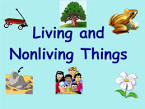 Young children often have difficulty characterizing things as living or nonliving. For example, they tend to describe anything that moves as alive. They also do not yet understand the cycle of life (birth, growth, death), and therefore classify as nonliving anything that has died. In science, livingis used to describe anything that is or has ever been alive (dog, flower, seed, road kill, log); nonliving is used to describe anything that is not now nor has ever been alive (rock, mountain, glass, wristwatch). Over time, students will begin to understand that all living things grow, breathe, reproduce, excrete, respond to stimuli, and have similar basic needs like nourishment. Older students may even realize that all living things are made up of cells.
Task
At the end of this lesson, you will be asked to develop the concept that all things can be classified as living and non-living things. Generalize that all living things need air, water, food and shelter. Discuss characteristics of living and non-living things.
Process
1. Ask each student to name one living thing and one nonliving thing. Write all their contributions on a paper or on the chalkboard, under the column headings "Living" and "Nonliving".
2. Tell students that they will be studying living things, or organisms. Have students reflect on the list of organisms they generated and think about all the features that make organisms "alive." Have them brainstorm answers to these questions:
- What are some characteristics of living things?
- What are some characteristics of nonliving things?
- What makes living things different from nonliving things?
3. Explain to students the scientific definition of living (anything that is or has ever been alive) and nonliving (anything that is not now nor has ever been alive). Remember that the difference between nonliving and dead can be confusing to youngsters. Give an example of something that is dead but still classified as living, such as a log.
4. Activity for Learning
Discuss with the children and develop theidea of ‘living things’ and ‘non-living things’ by trying to find out what living things do e.g. theygrow, they breathe, they eat, etc
Evaluation
Evaluation: A. Answer the following.a. Showing understanding of living and nonliving things through classification of pictures. b. Recognize the differences in size, shape,structure and mobility of plants and animals on aclass walk.c. Miming the facial characteristics and movements of a chosen animal. B.Write the name of all living things under theappropriate category. Living Things Non-living Things 1. 1. 2. 2. 3. 3. 4. 4. 5. 5.This will serve as guide and basis for judging the student's performance and output.
|
COMPREHENSION: Student will demonstrate adequate understanding of the theoretical foundations within the communication field. |
Lack of understanding of basic theories & models. |
Vague conceptions, but lack of clarity of theories and/or models. |
Good grasp of theoretical foundations. |
Very clear, comprehensive understanding of theoretical foundations. |
|
SPECTRUM OF KNOWLEDGE: How much knowledge does the student posses in the lesson? |
Very limited or lacking spectrum of knowledge. |
Very basic knowledge base. |
Fair to good amount of knowledge in field of study. |
Outstanding showcase of knowledge with extensive variety of resources. |
|
EXPRESSION: How well does the student express their knowledge of the subject matter? |
Confusing & unclear, with poor writing style. |
Acceptable writing style, with some errors in writing. |
Good demonstration of ideas & constructs & very few, if any, errors in grammar, spelling and punctuation. |
Fluent & direct expression. |
Conclusion
- Congratulations! It was awesome. Now you’ve developed the concept about the living and non living things.
- If you would like to learn more about living and non- living things, explore the following websites:
Credits
These are the references which you can check and visit for further details of the topic.

Teacher Page
WebQuest can be used during a science unit to introduce students to the characteristics of living things. It can also be used to teach students to differentiate between things as living or non- living.
Jonalyn L. Abat
Bachelor of Elementary Education
Major in Pre-school
Cyril L. Avila
Bachelor of Elementary Education
Major in General Education
Rina R. Pacao
Bachelor of Elementary Education
Major in General Education
Ivy P. Rodolfo
Bachelor of Elementary Education
Major in General Education
Judith R. Saboco
Bachelor of Elementary Education
Major in General Education
[img_assist|nid=16804|title=image|desc=|link=none|align=middle|width=535|height=201]