
Introduction
In the popular book and movie "Pay It Forward," 12 year old Trevor McKinney gets a challenging assignment from his social studies teachcer.
Think of an idea for world change, and put it into practice!
Trevor came up with an idea that fascinated his mother, his teacher, and his classmates.
He suggested that he would do something really good for three people. Then when they asked how they can each pay him back for his good deeds, he would tell them to "pay it forward" - each doing something good for three people.
Trevor figured that those three people would do something good for a total of nine others. Those nine would do something good for 27 others, and so on. He was sure that before long there would be good things happening to billions of people all around the world.
Task
To begin:
1.) At the start of the Pay It Forward process, only one person does good deeds - for three new people. In the next stage, the three new people each do good things for three new people. In the next stage, nine people ead do good things for three new people, and so on, with no person receiving more than one good deed.
a.) Make a table showing the number of people who will receive good deeds at each of the next seven stages of the Pay It Forward process. Then, plot the (stage, number of good deeds) data on a graph.
| Stage of Process | 1 | 2 | 3 | 4 | 5 | 6 | 7 | 8 | 9 | 10 |
| Number of good deeds | 3 | 9 | 27 |
b.) How does the number of good deeds at each stage grow as the tree progresses? How is that pattern of change shown in the plot of the data?
c.) How many stages of the Pay It Forward process will be needed before a total of at least 25,000 good deeds will be done?
Complete all of question 1 before moving on to the process page!
Process
Part 1: Tree Graphs
The number of good deeds in the Pay It Forward pattern can be represented by a tree graph that starts like this (each red dot represents a person who receives a good deed):
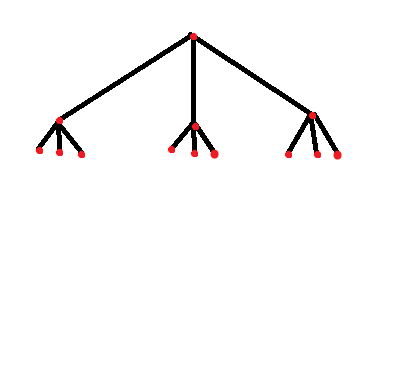
We'll be looking at how to represent this growth using symbolic rules (equations).
Create your own tree diagram for the following problem:
Let's consider the infamous chain letter (or text)! Occasionally you may receive a chain text from a friend that says if you forward the message to at least 5 people you will have good luck in the next 24 hours. However, if you fail to send this text to anyone you will be hit with 10 years of bad luck! Ouch! It seems kinda harsh so you forward the message.
Create a tree graph to show how the first 3 stages of forwarding the message. Assume that the chain text began with 1 person. Put your answer under question 3 of your worksheet.
Now, sketch a graph of the first five stages of data. Is there a linear relationship between the stage and the number of people who have received the text? If not, how is this apparent in both the tree graph and the coordinate graph?
Part 2:
In the Pay It Forward that you have studies (in the process and part 1), you can use the number of good deeds at one stage to calculate the number of the next stage.
a.) Use the words NEXT and NOW to write a rule that expresses the pattern.
b.) Write a NOW and NEXT rule for the chain text pattern.
c.) Describe how these rules are both similar and different.
Evaluation
Today you will be evaluated on the QUALITY of your work. Good quality shows time and effort. Bad quality shows little to no efforst.
Conclusion
Homework (if not complete in class):
Suppose a single bacterium lands in a cut on your hand. It begins spreading an infection by growing and splitting into two bacteria every 20 minutes.
1.) Complete a table showing the number of bacteria after each 20 minute period in the first 3 hours.
| Number of 20 minutes periods | 1 | 2 | 3 | 4 | 5 | 6 | 7 | 8 | 9 |
| Bacteria Count | 2 | 4 |
2.) Use NOW and NEXT to write a rule relating number of bacteria at one time and the number 20 minutes later. Then use the rule to find the number of bacteria after fifteen 20 minute periods.