
Introduction
Welcome to your self-learning experience! You'll be working on becoming a life-long learner today. One of my ultimate goals as a teacher is to equip you with the necessary skills to continue to learn on your own the rest of your life.
Before you begin, take a look at the following website:
http://www.mathsisfun.com/algebra/quadratic-equation.html
This website gives you a great introduction to quadratic functions. Follow your learning guide today. It will walk your through the process and allow you to gather your thoughts. Enjoy the ride! And, as always, I am here to support you so ask questions as you have them!

Task
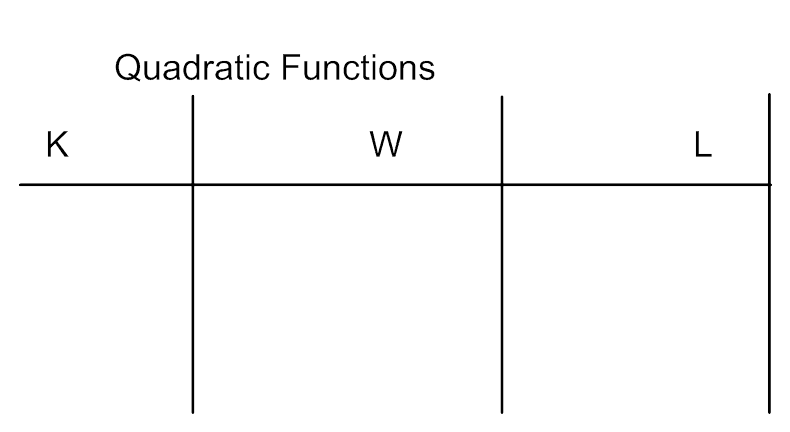
You'll be using your KWL chart to track what you already know, what you want to know, and what you have learned.
Go ahead and fill out as much as you can about what you already know about quadratic functions. It can be as little or as much as you want. The more you already know, the better foundation you have for building new knowledge.
Your objectives for this lesson are as follows:
1.) I can define the patterns of change associated with quadratic functions
2.) I can use tables of values and graphs to estimate answers about situations modeled by quadratic patterns
3.) I can describe the effects of each parameter in the function rule y=ax^2+bx+c
Since this is what you want to know, go ahead and put these objectives under W (which stands for what I want to know).
Process
TASK 1:
Smashing Pumpkins
The current distance record for Punkin' Chuckin' is over 4,000 feet. Such a flight should take the pumpkin very high in the air as well.
a.) Which of theses graphs is most likely to fit the pattern relating pumpkin height to time in flight? Explain choice.
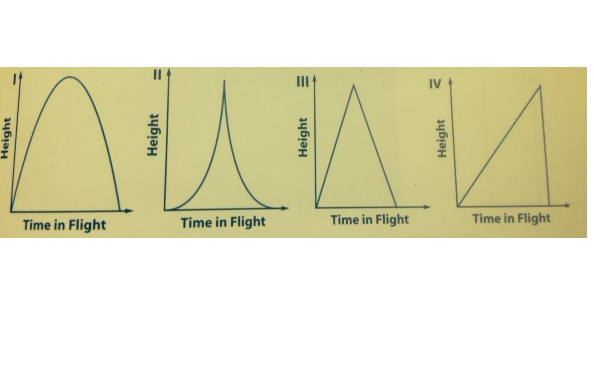
b.) What pattern would you expect to find in data relating pumpkin height to elapsed time? Be specific in your description. When will it be increasing, and when will it be decreasing?
TASK 2:
Pumpkin' Droppin'
At Old Dominion University in Norfolk, VA. physics students have their own flying pumpkin contest. Each year they see who can drop pumpkins on a target from 10 stories up in a tall building while listening to music by the group Smashing Pumpkins.

By timing the flight of the falling pumpkins, the students can test scientific discoveries made by Galileo Galilei nearly 400 years ago. Galileo used clever experiments to discover that gravity exerts force on any free falling object so that d, the distance fallen, will be related to time t by the function:
d=16t^2 (time in seconds and distance in feet)
For example, suppose that a student dropped a pumpkin from a point that is 100 feet above the ground. At a time 0.7 seconds after being dropped, the pumpkin will have fallen 16(0.7)^2=7.84 feet., leaving it 100-7.84=92.16 feet above the ground.
1.) Fill out your table on your learning guide to show estimates for the pumpkin's distance fallen and height above the ground in feet at various times between 0 and 3 seconds.
| Time t | Distance Fallen d | Height Above the Ground |
| 0 | 0 | 100 |
| 0.5 | ||
| 1 | ||
| 1.5 | ||
| 2 | ||
| 2.5 | ||
| 3 |
2.) Use data relating height and time to answer the following questions about flight of a pumpkin dropped from a position 100 feet above the ground.
a.) What function rule shows how the pumpkin's height h is related to time t?
b.) What equation can be solved to find the time when the pumpkin is 10 feet from the ground? What is your best estimate for the solution to the equation?
c.) What equation can be solved to find the time when the pumpkin hits the ground? What is your best estimate for the solution of that equation?
d.) How would your answers to Part a, b, and c change if the pumpkin were to be dropped from a spot 75 feet above the ground?
TASK 3:
High Punkin' Chuckin'
Compressed air cannons, medieval catapults, and whirling slings are used for the punkin' chuckin' competitions.
Imagine pointing a punkin' chuckin' cannon straight upward. The pumpkin height at any time t will depend on its speed and height when it leaves the cannon.

3.) Suppose a pumpkin is fired straight upward from the barrel of a compressed cannon at a point 20 feet above the ground, at a speed of 90 feet per second (about 60 miles an hour).
a.) If there were no gravitational force pulling the pumpkin back toward the ground, how would the pumpkin's height above the ground change as time passes?
b.) What function rule would relate height above the ground h in feet to time in the air t in seconds?
c.) How would you change the function rule in Part b if the pumpkin chunker used a stronger cannon that fired the pumpkin straight up into the air with a velocity of 120 feet per second?
d.) How would you change the function rule in Part b if the end of the cannon barrel was only 15 feet above the ground instead of 20 feet?
Task 4:
Now think about how the flight of a launched pumpkin results from the combination of 3 factors:
1.) Initial height of the pumpkin's release
2.) Initial upward velocity produced by the pumpkin launcher
3.) Gravity pulling the pumpkin downward toward the ground
a.) Suppose a compressed air cannon fires a pumpkin straight up into the air from a height 20 feet and provides an initial upward velocity of 90 feet per second. What function rule would combine these conditions and the effect of gravity to give a relation between the pumpkin's height h in feet and its flight time t in seconds?
b.) How would you change your function rule in Part a if the pumpkin is launched at a height of 15 feet with an initual upward velocity of 120 feet per second?
TASK 5:
By now you may have recognized that the height of a pumpkin shot straight up into the air at any time in its flight will be given by a function that can be expressed with a rule in the general form
h=h0+v0t-16t^2.
In those functions, h is measured in feet and t in seconds.
a.) What does the value of h0 represent? What units are used to measure h0?
b.) What does the value of v0 represent? What units are used to measure v0?
When a pumpkin is not launched staight up into the air, we can break its velocity into a vertical component and a horizontal component. The vertical component, the upward velocity, can be used to find a function that predicts change over time in the pumpkin's height. The horizontal component can be used to find a function that predicts change over time in the horizontal distance traveled.
TASK 6:
The pumpkin's height in feet t seconds after it is launched will be given by h=ho+v0t-16t^2. It is fairly easy to measure the initial height (h0) from which the pumpkin is launched, but it is not so easy to meausre the initial upward velocity (v0).
a.) Suppose that a pumpkin leaves a cannon at a point 24 feet above the ground when t=0. What does that fact tell us about the tule giving height as a function of time in flight t?
b.) Suppose that you were able to use a stopwatch to discover that the pumpkin shot described in Part a returned to the ground after 6 seconds. Use that information to find the value of v0.
Evaluation
You will be evaluated based on your effort and input today. Rushing through the process and turning in sloppy work only holds you back. Be an anomaly today! In other words, be different and go above and beyond what is expected! You can do this!
Conclusion
Once you have completed all seven tasks on your learning guide, return to your KWL chart at the beginning and answer what you have learned about your 3 objectives. Be thorough and make sure to repond to all 3 objectics (meaning you should have learned at least 3 things).
Once you are finished with your learning guide and you have had it checked by Mrs. Donabo, you have 3 options:
1.) Work on your Discussion post
2.) Make midterm corrections
3.) Work on your exponential homework for Friday