
Introduction
"Legs On Fire": Nursing Assessment of Compartment Syndrome WebQuest
By Alexandra Scheinfeld, MSN, RN
As nurses in a busy pediatric emergency department, it is easy to get caught up in the bustle of the day. Despite our best efforts, sometimes assessment of neurovascular status of an injured extremity falls to the bottom of our priority list. Unfortunately, 69% of compartment syndrome cases are caused by fractures (Medscape, 2014). Every nurses' worst nightmare is to leave the room of a patient with a well perfused injured extremity only to return to a cold, swollen, exquisitely painful limb when completing a subsequent assesment hours later:
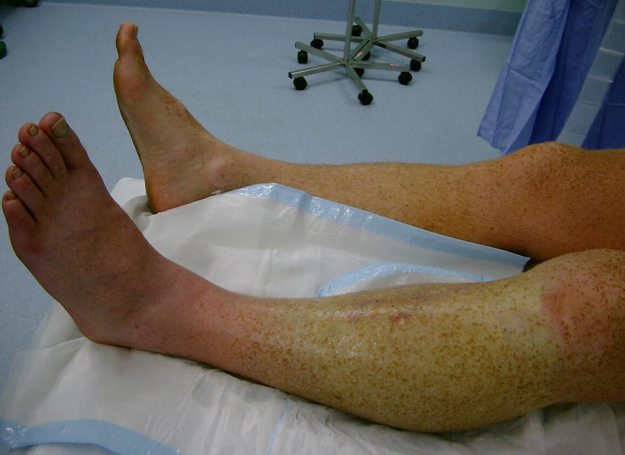
Image courtesy of LifeInTheFastLane.Com
The purpose of this WebQuest is to guide the pediatric emergency department nurse in exploring existing online resources about compartment syndrome to enhance knowledge of the pathophysiology behind compartment syndrome and accompanying symptoms that nurses should be vigilant for when assessing patients with an extremity trauma.
Task
Your Task
Four (4) Trauma Hour CEU's will be awarded for completion of this module and accompanying assignment.
To receive the trauma hours for completing this WebQuest, you will be required to create a concept map of signs, symptoms, and risk factors for patients with an injured extremity who may be susceptible to compartment syndrome. Concept maps are an engaging way to create a visual representation of the critical thinking that nurses use every day when taking care of patients (Senita, 2008).
Information on concept maps can be found here:
Below is an example of a concept map for a patient with a spinal cord injury.
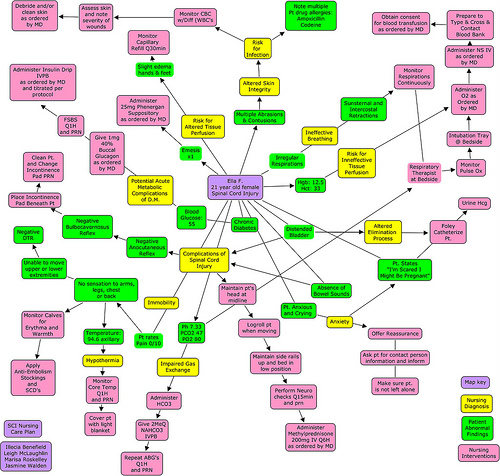
Image Courtesy of Flickr
Notice how the nurse started with the patient in the center and worked outward with interrelating categories such as potential and actual nursing diagnoses, abnormal assessment findings, and nursing interventions. Before submitting your concept map, show your work to a colleague and see if they can help you think of any other data points to add to your map.
For this exercise your patient can be a real case you encountered (do not violate HIPAA) or a fictional pediatric trauma extremity patient who is at risk of compartment syndrome. More information on what is required in your concept maps will be outlined on the evaluation page of this WebQuest.
Your concept map may be hand drawn on paper, written out on a whiteboard and turned in as a high quality photograph where all print is legible, or computer generated. There are many programs that have free trials for creating concept maps using the computer:
Process
Compartment Syndrome WebQuest
In this section you will find selected resources to enrich your nursing knowledge about patients who may be at risk for compartment syndrome and nursing assessments. While browsing feel free to click links and explore different resources that are not specifically listed in this module to enhance learning.
While exlporing the content below, be sure to take notes on the following topics that will be useful additions to your concept map:
- Types of traumatic injuries that put a patient at risk for compartment syndrome
- Potential or actual nursing diagnoses that can be applied to this patient population
- Early and late nursing assessment findings that indicate risk for developing compartment syndome
- Possible nursing interventions
To begin your guided exploration of compartment syndrome resources online, please review the following for a detailed overview of compartment syndrome:
1. Review this useful graphic to understand how increased pressure in one of the compartments of the lower leg can lead to compartment syndrome:
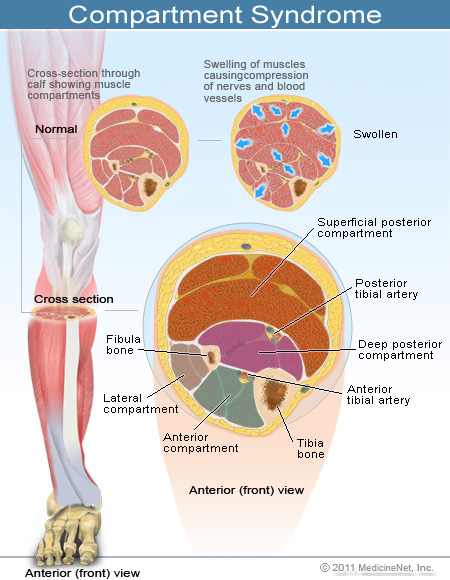
Image Courtesy of MedicineNet.Com
2. Read through this Basic Overview of Compartment Syndrome (focus on acute compartment syndrome as related to trauma)
3. Now fill in areas of knowledge gap by learning about the History of Compartment Syndrome, as well going more in depth with Anatomy, Pathophysiology, Etiology, Epidemiology, and Prognosis of the patient suffering from compartment syndrome
4. Read this Interview of two orthopedic surgeons regarding compartment syndrome. Again, focus on acute traumatic compartment syndrome for your concept map.
5. Watch this video of a patient recieving a fasciotomy as treatment for compartment syndrome. Pay attention to how far the skin retracts when the pressure is relieved by cutting the fascia.
[video:https://www.youtube.com/watch?v=PUQiexqRRHg align:center]
6. Read the lived experience of a patient who kept a blog chronicling How She Felt When She Needed a Fasciotomy. While on the blog site, feel free to read some of her other entries, including one covering the Testing she needed to be diagnosed with compartment syndrome.
7. Read the abstact of this 2014 Literature Review that reveals some of the biggest risk factors for developing compartment syndrome. If you are able to get access to the article, feel free to read more in depth about the studies used for this review.
8. Test your knowledge by answering the questions in this Case Study. See how many questions you can answer on your own before revealing the correct answers and rationale.
Evaluation
Concept Map Rubric
Please use the following rubric to guide your work when creating the concept map for trauma hours credit. Concept maps must receive an 80% or higher to pass this WebQuest.
Concept maps that receive a score of less than 80% will be returned to the author with feedback. Revised versions must be handed in no later than 7 days after the insufficient concept map was returned. Remember, this is a learning exercise to explore the critical thinking you use every day as a nurse, so have fun with it!
| Unacceptable (<15) |
Needs Improvement (15-19) |
Satisfactory (20-24) | Exemplary (25) | |
| Identifies Appropriate Patient Case for Basis of Concept Map | Identifies a completely unrelated patient population | Identifies trauma patient who is not at risk for compartment syndrome | Identifies a trauma patient who may be indirectly at risk for compartment syndrome | Identifies a pediatric trauma patient who is at high risk for compartment syndrome related to their injury |
| Nursing Diagnoses | Includes less than four (4) potential or actual nursing diagnoses on concept map | Includes four (4) nursing diagnoses, none are related to trauma or compartment syndrome |
Includes four (4) nursing diagnoses, but not all are directly relevant to the patient who is at high risk for compartment syndrome |
Includes at least four (4) appropriate potential or actual nursing diagnoses directly related to the patient who is at high risk for compartment syndrome |
| Assessment Findings | Includes less than six (6) assessment findings on concept map | Includes at least six (6) assessment findings, none are related to trauma or compartment syndrome | Includes at least six (6) assessment findings, but not all are directly relevant to the patient who is at high risk for compartment syndrome | Includes at least six (6) assessment findings directly related to the patient who is at high risk for compartment syndrome |
| Nursing Interventions | Includes less than two (2) nursing interventions on concept map | Includes at least two (2) nursing interventions, none are related to trauma or compartment syndrome | Includes at least two (2) nursing interventions, but not all are directly relevant to the patient who is at high risk for compartment syndrome | Includes at least two (2) nursing interventions directly related to the patient who is at high risk for compartment syndrome |
Credits
References:
Ali, P., Santy-Tomlinson, J., Watson, R. (2014). Assessment and diagnosis of acute limb compartment
syndrome: a literature review. International Journal of Orthopaedic and Trauma Nursing, (18), 180-
190.
Medscape. (2014). Retrieved from http://emedicine.medscape.com/article/307668-overview#a0156
Senita, J. (2008). The use of concept maps to evaluate critical thinking in the clinical setting. Teaching
and Learning in Nursing, (3), 6-10.
Special thanks to all of the authors of the web based content included in this WebQuest.
Permissions:
We all benefit by being generous with our work. Permission is granted for others to use and modify this WebQuest for educational, non-commercial purposes as long as the original authorship is credited. The modified WebQuest may be shared only under the same conditions.

About the Author:
Alexandra Scheinfeld, MSN, RN received her Master of Science in Nursing Education from Georgetown University in December, 2014. She currently works as a nurse in the Emergency Department of a busy urban pediatric Magnet-designated research hospital that serves as a Level I Trauma Center. She also writes as a columnist for the lifestyle and education section of NurseTogether.com.
Teacher Page
This page serves as a guide for nurse educators who wish to use this WebQuest in the future.
Teacher Introduction:
The purpose of this WebQuest is to guide the pediatric trauma nurse in a search of existing literature and online resources regarding compartment syndrome. As an evaluation method, nurses are required to put their critical thinkings skills to the test by creating a concept map that links together assessment, diagnoses, and actions surrounding the nursing care of a patient at risk for compartment syndrome.
Learners:
This WebQuest is designed for licensed registered nurses who work with pediatric trauma patients. This WebQuest is suitable for all levels of nursing experience from new graduate to clinical expert.
Teacher Process:
After the nurse completes the WebQuest, concept maps are graded using the rubric included in the evaluation section to ensure that important and relevant information is included.
Resources:
All resources used are included in the credits section or embedded within the WebQuest module.