
Introduction
How do living things interact?
Think about it! How many roles do you have in your environment? You're someones child, a grandchild, possibly a brother or sister, a student. In each role, you interact differently!
Task
Okay team 6-2,
Today you will explore different groups which make up an ecosystem and their interactions. For this activity you will use your text book (or its internet site) and the internet resouces provided within this webquest
Materials Needed Today:
- worksheet
- Piece of Paper
- Pencil
- Computer
- A Positive Attitude!
Directions:
Click on the links provided and explore each website's information, videos, quizzes, games and simulations.
Process
You will complete one section of the chapter at a time! Each section name is linked to the text book, so you will not need to take it out.
Click on Section 2.1 and it will bring you to your textbook!
2.1 Groups of living things interact within ecosystems. Pages 45-51
A. Organisms occupy specific living areas.
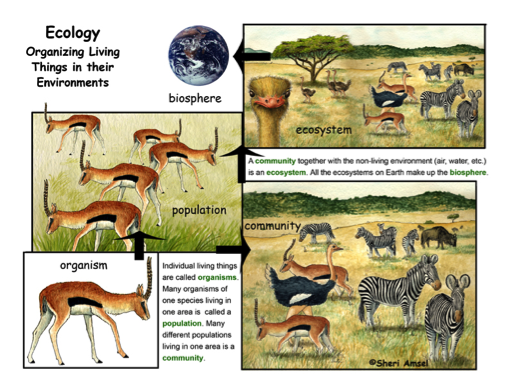
- What is Species?
- What is a population?
- Name 3 different populations found on the Galapagos Islands
- What is a habitat?
- Name two characteristics that will describe a habitat.
- Explain the interactions between these populations.
- What is a niche and give an example?
- What is a community?
- How are communities distinguished?
After using your textbook for questions #1-9 go to this link to reinforce what you have learned.
B. The environment can be organized into five levels.
List them from largest to smallest # 1-5 on your worksheet.
C. Patterns exist in populations:
- What is an example of “patterns in space?”
- What is an example of “patterns in time?”
2.2 Organisms can interact in different ways.
A. Organisms interact in different ways
- What is a predator and a prey and give one example of each?
- What is competition and give one example?
B. The survival of one species might depend on another species
- Define symbiosis and each of the three types: mutualism, commensalism, and parasitism. Additional resource:http://www.biology4kids.com/files/studies_relationships.html
-
Use this site to answer the following questions: http://www.marietta.edu/~biol/biomes/symbiosis.htm
-
Explain why the symbiotic relationship between a winged dove and the saguaro cactus is mutualism.
- Explain why the symbiotic relationship between a clownfish and the anemone is mutualism. Can you name a movie where this was illustrated?
- Describe the parasitic relationship between a spider and a wasp.
- Bromeliads (plant) are said to have a commensal relationship with certain tree branches. Explain that relationship and describe how this relationship can change. http://www.marietta.edu/~biol/biomes/symbiosis.htm
2.3 Ecosystems are always changing Text pp.63-68
A. Populations change over time.
View: Ecologic succession http://www.youtube.com/watch?v=k03vxRYsJ4Y
- Define limiting factors and give two examples from the text. Limit factors cartoon:: http://www.youtube.com/watch?v=8FPMP41LYJ8
- What is carrying capacity?
- What is the carrying capacity of deer 75 acres of land
B. Ecosystems change over time
- What does succession mean?
- Define Pioneer species and give an example. (text ) Take a look at this site! http://www.youtube.com/watch?v=CYC87ocRoJc
- What is Primary succession?
- What is Secondary succession?
- How do they differ? http://www.youtube.com/watch?v=YkZgKs6Dgkk
- List the pattern of change