
Introduction
What are Feature Stories?
Based on the definition that we can find on the University or North Carolina at Pembroke (www2.uncp.edu), we can say that feature stories are human-interest articles that focus on particular people, places and events.
They cover topics in depth, going further than mere hard news coverage by amplifying and explaining the most interesting and important elements of a situation or occurrence.
Feature stories are popular content elements of newspapers, magazines, blogs, websites, newsletters, television broadcasts, and other mass media, such as online videos or podcasts.
While journalists reporting late-breaking hard news don't have enough time and space to include much background and description, writers or producers of features do have the space and time to evoke imagery in their stories and fill in details of the circumstances and atmosphere.
Actually, the key of a good feature story is the chance of having an in-depth look at a subject.
Types of Features
There are many kinds of feature stories. Some of the popular ones are...
- Human Interest: it discusses issues through the experiences of another.
- Profiles: it reveals an individual's character and lifestyle, exposing different facets of the subject so the audience will feel they know the person.
- Historical Features: These features commemorate important dates in history or turning points in our social, political and cultural development.
Here you will find more descriptions of the most popular types of Feature Stories (for your consideration: the tips of this site are for written articles, but as they are quite general, they can be useful for your video project):
http://www2.uncp.edu/home/acurtis/Courses/ResourcesForCourses/WritingFeatureStories.html
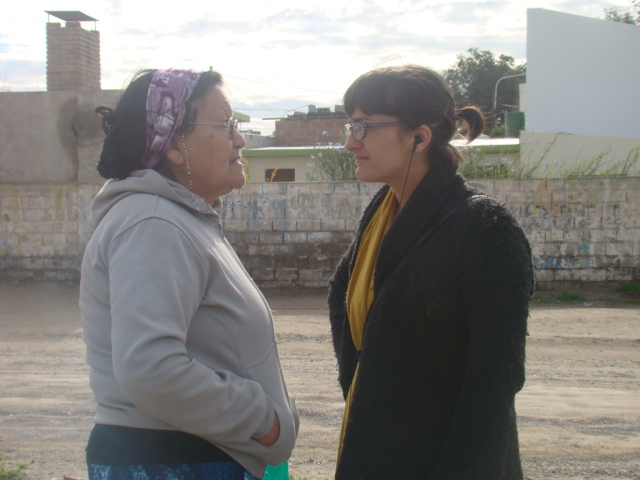
Task
Your own Feature Story
In a group of three people, you will have to produce an original Feature Story Video. Its duration must be between 3 and 6 minutes. The final production must include:
- at least, part of an interview with one person
- pictures or video related to the topic
- music
- narration (off voice)
The link to the video must be sent by email to your teacher (lulagrandon@gmail.com) until August 15th, 2014.
Process
The prime material for a Journalistic Feature Story is the interview.
A successfull interview is a result of a previous process that includes choosing a general topic, narrowing it to a specific point of view on that topic, and, based on that, choosing a number of people who will be interviewed.
Some, or part, of these interviews will never be published. But all of them will be the material on which you will work to make your Feature Story.
Besides, in the research process, you can also find out information on the web, newspapers articles, books, etc.
In this case, your Feature Story must include:
part of an interview
narration
images to illustrate (pictures, video)
music
Don't forget to mention all the sources you use in the process!
The idea is that you edit the slideshow of pictures, including a narration (it can be your own "off voice"), add video images and, at least, the audio of an interview.
To organize the material, it is a good idea to take into account the traditional structure of Introduction-Development-Conclusion.
The following are basic Feature Story Videos that give us information using only a narration, music and a slideshow...
[video:http://youtu.be/la4NHwpFwCY align:center]
[video:http://youtu.be/B65MOfALDiw align:center]
Here, there is another example, part of a Feature Story produced for TV, where videos of the interviews and other images that illustrate the topic, are included, as well as music and an off-voice narration...
[video:http://youtu.be/uWd5rRw-zBY align:center]
As it was said at the beginning of this section, interview is one of the most important tools for the process of gathering information, which in this case will lead to a Feature Story. Other two relevant things are: observation and background research.
Interviewing and observing, jotting down everything encountered – smells, noises, colors, textures, emotions, details seen and heard in the surroundings. And in video, the way of showing this is by means of images and music (or even sound efects!)
Remember!!! Keep an open mind while interviewing subjects and researching sources.
Good luck! ;)
More information at...
http://www2.uncp.edu/home/acurtis/Courses/ResourcesForCourses/WritingFeatureStories.html
Evaluation
This project will be considered approved if...
- The video is an original production.
- The link to the video is sent by e-mail until August 15th, 2014.
- It lasts 3 to 6 minutes.
- The music, images and narration are consistent with the topic.
- The quality of audio and images is good and clear.
- Credits are complete and accurate.
- The conclusion is sent by e-mail before August 21st, 2014. (For more information, check the "Conclusion" page in this site.
Conclusion
As a Conclusion, students will have to send a written report (Arial 11, ine spacing: 1.5) including their opinions and personal points of view on the stories or topics they have worked on throughout the process of the Feature Story.
That report must be sent by e-mail to the teacher (lulagrandon@gmail.com) before August 21st. 2014.
Credits
For this WebQuest I have used material from...
- http://www2.uncp.edu/home/acurtis/Courses/ResourcesForCourses/WritingFeatureStories.html
- Youtube videos
- Pictures taken during or after interviews
- And what I remember and have learnt from my training course in Radio and TV Broadcasting
Teacher Page
The objective of this webquest is to ask adolescents or adults advanced students of English to create a video presentation where they can tell a story. It can be about a person, a place, a historical event, etc.
The "format" chosen is the Feature Story, originally a written journalistic genre, that can be adapted to audio or multimedia standards.
The choice of a video production instead of a piece of writing is based on considering the grammar, spelling and language limitations that students may have. Also, it was taken into account how much interest podcasting and video streaming produce in young learners today.
However, there is a written instance in the task, which is the Conclusion. There, students have to send a brief report where they must give their opinion or make an informal analysis on the topic chosen.
Besides grammar, language, spelling and other items considered in the evaluation, this activity is a great opportunity to invite young people to interact and socialize with other people, face to face, and show their creative or artistic potential.