Introduction
Accidents happen, and knowing how to respond quickly and correctly to bleeding wounds can save lives. In this WebQuest, you will become confident in recognizing different types of bleeding and wounds, understanding the signs of internal bleeding, and learning how to properly treat wounds using dressings and bandages. This hands-on knowledge is essential for anyone interested in health science or emergency care.
Task
Your final goal is to create an instructional guide or video that teaches others:
- How to differentiate arterial and venous bleeding.
- How to identify common wound types: abrasions, lacerations, punctures, and amputations.
- How to recognize signs and symptoms of internal bleeding.
- How to properly treat minor and major wounds using dressings and bandages.
Use your guided notes handout to go through the steps and fill in the blanks to collect the information needed to create your instructional guide or video.
Process
Step 1: Learn About Types of Bleeding
- Research and write down the differences between arterial bleeding and venous bleeding in your guided notes:
- Use this resource to help: https://cpraedcourse.com/blog/arterial-vs-venous-bleeding/#
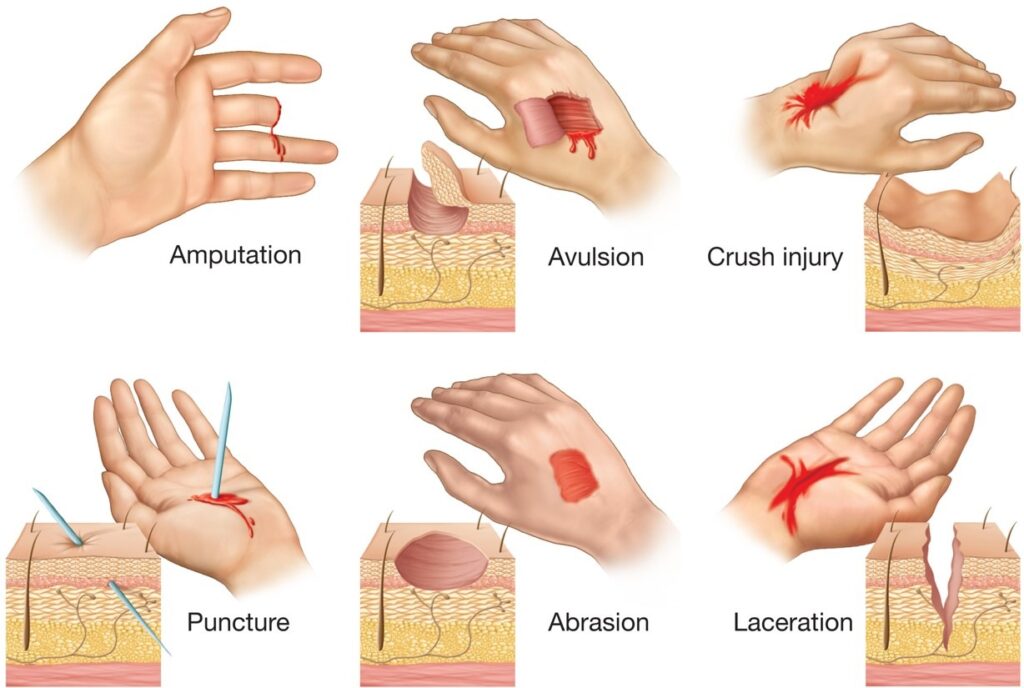 Step 2: Identify Wound Types
- Research and describe the following wounds in your guided notes:
- Abrasion
- Laceration
- Puncture
- Amputation
- Watch the video for visuals and explanations here:
https://www.youtube.com/watch?v=kTZpj09rqDo Step 3: Recognize Internal Bleeding Signs
-
- Learn the signs and symptoms of internal bleeding and write them down in your guided notes to use for your instructional guide/video.
- Read this detailed overview:https://my.clevelandclinic.org/health/diseases/internal-bleeding#symptoms-and-causes
Step 4: Treating Major and Minor Wounds
- Review and write down the steps for the following in your guided notes:
- Treating minor wounds (cleaning, dressing application)
- Managing major wounds (controlling bleeding, applying pressure, bandaging)
- Watch these demonstration videos for practical tips to help you in creating your instructional guide/video:
Major:
Minor:
Dressing/Bandages:
Step 5: Create Your Instructional Guide or Video
- Organize your knowledge into a clear and engaging instructional guide or video using your notes and the resources above.
- Include:
- How to identify bleeding type and wound type.
- Signs of internal bleeding to watch for.
- Step-by-step first aid treatment for minor and major wounds.
- Proper methods for applying dressings and bandages.
- Use visuals, bullet points, and/or demonstrations to make your guide easy to follow.
- You can create this on Canva or another online platform of your choosing if you are doing an instructional guide.
- When you complete your instructional guide/video turn it in on google classroom under the First Aid: Bleeding/Wounds Assignment
Evaluation
You will be evaluated on your instructional guide/video using this rubric below:
| Criteria | Excellent (4) | Good (3) | Fair (2) | Needs Improvement (1) |
|---|---|---|---|---|
| Understanding of Bleeding Types | Clear differentiation of arterial vs venous bleeding | Mostly clear with minor gaps | Basic or partial understanding | Little or no understanding |
| Identification of Wound Types | Accurate identification and descriptions | Mostly accurate with some errors | Some errors or missing info | Inaccurate or incomplete |
| Recognition of Internal Bleeding | Thorough identification of signs/symptoms | Adequate recognition | Limited recognition | Fails to recognize signs |
| Treatment Procedures | Correct, detailed, and well-explained steps | Mostly correct with minor omissions | Basic or incomplete procedure | Incorrect or missing procedure |
| Instructional Guide Quality | Clear, engaging, creative, and accurate | Clear and mostly organized | Somewhat unclear or incomplete | Poorly organized or confusing |
Conclusion
Congratulations! You have completed the webquest!
You now have the essential knowledge and skills to handle bleeding wounds safely and effectively. This understanding can make a real difference in emergencies. Keep practicing and sharing what you’ve learned to be ready to help when it matters most.
Remember: You will also be assessed during skills check-offs to demonstrate proper procedures for treating bleeding wounds, dressing application, and bandaging according to this standard. Be prepared to show your competence with confidence!
Credits
https://cpraedcourse.com/blog/arterial-vs-venous-bleeding/#
https://www.youtube.com/watch?v=kTZpj09rqDo
https://my.clevelandclinic.org/health/diseases/internal-bleeding#symptoms-and-causes
Teacher Page
This WebQuest introduces students to the essential knowledge and skills for treating bleeding wounds, focusing on differentiating arterial and venous bleeding, identifying wound types, recognizing signs of internal bleeding, and applying correct first aid procedures including dressing and bandaging.
You can use DHO Health Science, 9th Edition as your primary textbook, particularly the sections on First Aid (Chapter 17). This will provide a solid foundation for students to understand the concepts and procedures required by the standard.
In addition, the following supplementary resources enrich the learning experience by offering detailed explanations, visual aids, and practical demonstrations:
- Arterial vs Venous Bleeding (CPR AED Course blog)
https://cpraedcourse.com/blog/arterial-vs-venous-bleeding/# - First Aid for Bleeding Wounds - YouTube Demonstration
https://www.youtube.com/watch?v=kTZpj09rqDo - Internal Bleeding: Symptoms and Causes (Cleveland Clinic)
https://my.clevelandclinic.org/health/diseases/internal-bleeding#symptoms-and-causes
Students will create an instructional guide or video that demonstrates their understanding of bleeding wound types and first aid treatment procedures. This activity encourages critical thinking, application of knowledge, and communication skills. This activity will help students with hands-on skills check-offs, where students demonstrate proper treatment steps for minor and major wounds, dressing application, and bandaging techniques to meet the performance expectations of the standard.
There are many first aid worksheets, videos, and practical exercises available in the DHO workbook as well as, online that align well with this WebQuest.
Standards
Healthcare and Clinical Services Grade 10-12
Unit 6: First Aid; Objective 2: Describe and demonstrate the concepts for treatment of bleeding wounds and the application of dressing and bandages.
- 2a. Differentiate between arterial bleeding and venous bleeding.
- 2b. Identify types of wounds: abrasions, lacerations, puncture, amputation.
- 2c. Identify signs and symptoms of internal bleeding: tenderness, swelling, deformity, cold and clammy skin, rapid and weak pulse, drop in blood pressure, restlessness, excessive thirst, vomiting blood, blood in urine and feces.
- 2d. Apply the proper procedure for treating a major and minor wound.